INTRODUCTION: High-intensity interval training (HIIT) is a safe, time-efficient approach to improve aerobic fitness and performance (Mølmen et al., 2024), even in older adults with reduced metabolic flexibility (Chrøis et al., 2020). Notwithstanding, HIIT adaptations vary across exercise intensities, and their effects on metabolic and autonomic responses remain insufficiently characterized.
This study sought to examine the effects of a 6-week supervised HIIT intervention on metabolic flexibility and cardiac autonomic regulation in active postmenopausal women. Specifically, it aims to examine HIIT training-induced changes in substrate utilization and vagal-related Heart rate Variability (HRV) indices at intensities corresponding to Maximal Fat Oxidation (MFO), and Maximal Carbohydrate Oxidation (MCO) (Monferrer-Marín et al., 2026). The five sit-to-stand-test (5STS) was used as an indicator of lower-limb muscle power and functional performance relevant to activities of daily living.
METHODS: Twenty active women (66.6±6.2 years; 67.9±11.1 kg) volunteered to participate and completed 8 weeks of training of which the last 6-weeks corresponded to a HIIT protocol. (five 1-min bouts at 170–184% of the power output achieved at MCO intensity, interspersed with 1-min active recovery at 0.5 W/kg; 20-min sessions, three times per week). Intensity progressed gradually from 90% to 170% in the two previous weeks.
Experiments were carried out after ethical approval in line with Declaration of Helsinki (2024-FIS-3251696). Statistical analyses and figures were generated using Python 3.13.3 (Python Software Foundation, Wilmington, DE, USA). Normality was tested (Shapiro–Wilk). Paired comparisons were then performed using Student’s t-test or the Wilcoxon signed-rank test for body composition, BMR, muscular power, and key metabolic variables at MFO and MCO. Bar plots illustrated variables by intensity domain. Deltas were calculated for efficiency, carbohydrate oxidation, blood lactate, and VO₂ at MCO, and for fat oxidation, SampEn at MFO, and relative power at both intensities. Scatter plots assessed pre–post changes and age effects. Effect sizes were computed using Cohen’s d.
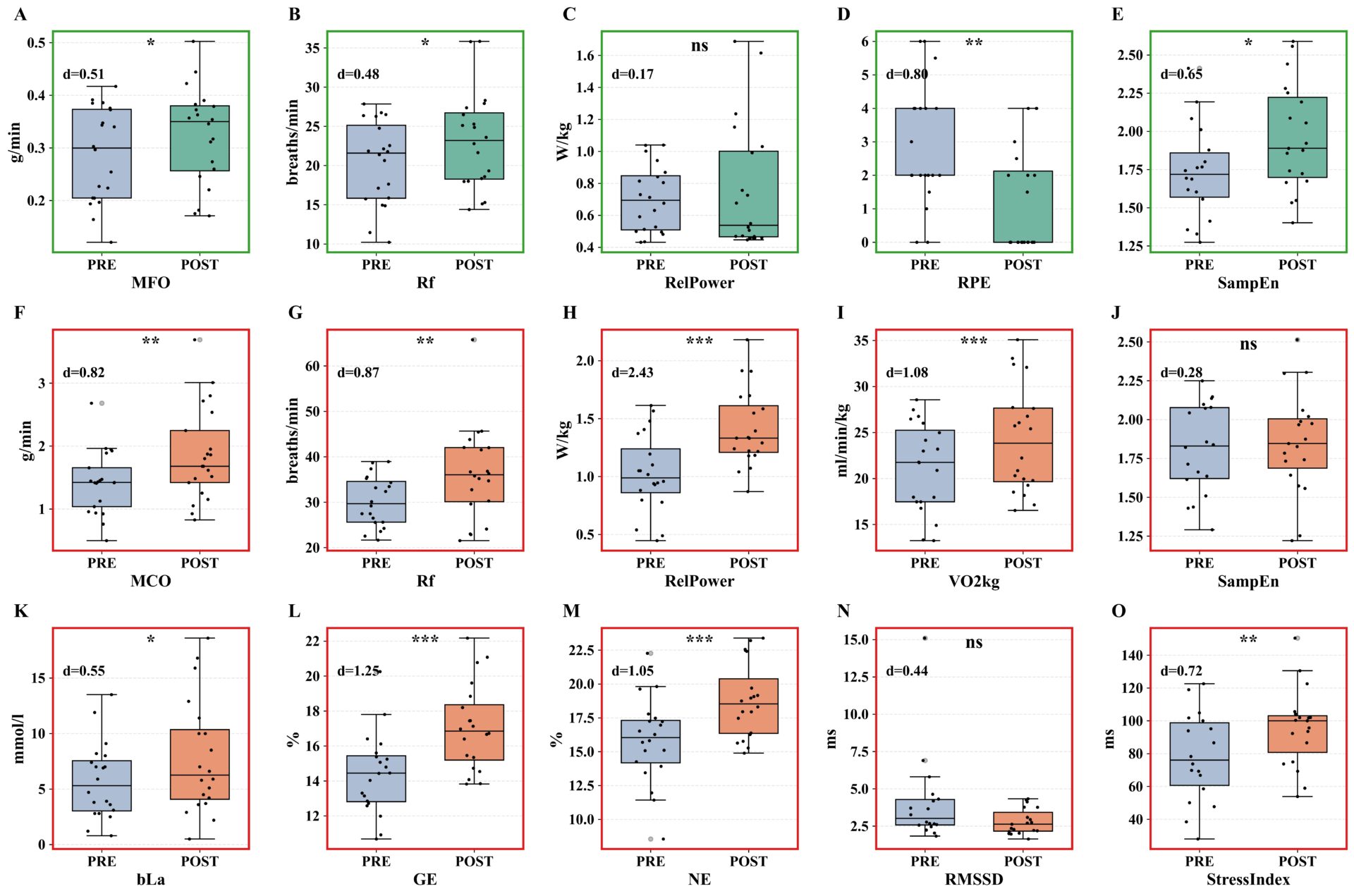
RESULTS: At MCO intensity, relative power (d=2.43), Net & Gross efficiency (d=1.26, 1.05), maximal oxygen consumption (d=1.08), respiratory rate (d=0.87), blood lactate (d=0.55), MCO rate (d=0.80) and relative power (d=1.11) increased following HIIT. Stress index also increased (d=0.72). At MFO intensity, maximal fat oxidation rate increased from 0.28±0.09 to 0.32±0.09 g/min (d=0.51), simultaneously with a decrease in perceived exertion (d=0.80), and increased respiratory frequency and sample entropy (d=0.48; d=0.65, respectively).
CONCLUSIONS: Our findings confirm significant beneficial physiological adaptations in active postmenopausal women after a 6-week HIIT program. At FATmax intensity, fat oxidation increased without a shift in the workload corresponding to MFO, accompanied by higher sample entropy. This greater cardiac autonomic complexity may support better fat oxidation regulation. At MCO intensity, improvements were observed in mechanical output, oxygen consumption, carbohydrate oxidation, and blood lactate, together with increased sympathetic activation and higher gross and net efficiency, despite age-related constraints.
Additionally, improvements in relative muscle power (5STS) highlight physiological and functional effectiveness of this short HIIT intervention, supporting its safety and time-efficiency in postmenopausal women. Overall, these results suggest intensity-specific adaptations consistent with enhanced autonomic–metabolic integration.