
Professor Andrew Jones awarded the 2026 GL Brown Annual Public Prize Lecture
“I am delighted to be named as the Society’s GL Brown Annual Public Prize Lecturer for 2026 and to have the opportunity to speak about the physiological underpinnings to breaking barriers in endurance sport,” says Professor Andrew Jones (Andy), Professor of Applied Physiology at the University of Exeter (UK). Andy has been applying his research to help athletes enhance their performance, a motivation driven from his years as an elite runner. “While my own running fell somewhat by the wayside (at least at the elite level), I have continued to be fascinated by the physiological factors that determine performance.”
Andy’s career as a physiologist “started on the athletics track at Chepstow comprehensive school”. As he pursued middle-distance running to elite level, it “gradually led to an obsession for understanding the physiological limitations to exercise, the adaptations that occur with training, and the nutritional and environmental factors that can influence performance,” recounts Andy. He then chose a degree in sports science; followed by a PhD in exercise physiology and a postdoc in respiratory medicine. He is now Professor of Applied Physiology in the Department of Public Health and Sport Sciences at the University of Exeter.
Andy is interested in endurance exercise. He is researching all things related to oxygen uptake (VO2), covering VO2 max, kinetics, metabolic thresholds, exercise-related fatigue processes and exercise tolerance. A focus of his investigations is what could limit the supply and use of oxygen during exercise and understanding its consequent effects.
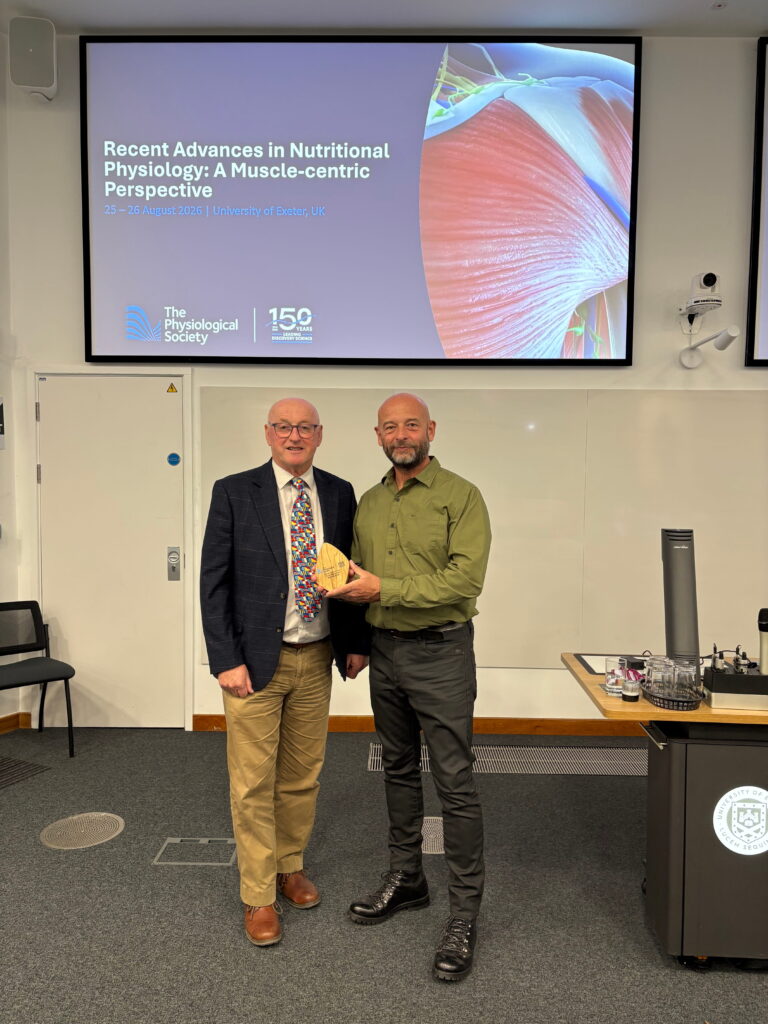
Today, he delivered ‘Breaking barriers, from the mile to the marathon: physiological determinants of sporting success’ his GL Brown Annual Public Prize Lecture at our meeting, ‘Recent Advances in Nutritional Physiology: A Muscle-centric Perspective’ at University of Exeter, UK. This is the Society’s annual public lecture to stimulate an interest in physiology.
He broke down the physiological requirements and the physical characteristics of the athletes capable of running a marathon in under two hours, and running a mile in under four minutes, both momentous feats. We discovered that Andy was successful in his quest to break the two-hour barrier in the men’s marathon. He was part of Nike’s Breaking 2 project where he got to work with former world marathon record holder Eliud Kipchoge. “Working with top athletes remains a source of inspiration and I find my research and applied work to be entirely symbiotic. Despite advances in many other scientific fields, physiology remains the main factor that explains sports performance.”
Andy discussed the factors that could enable athletes to reach their physiological potential, covering the environment, footwear innovation, nutrition, pacing and drafting. He also speculated on the different physiological challenges that occur for women to break the four-minute barrier for the mile, a record that is being chased. Faith Kipyegon, three-time Olympic champion in the 1500 metres, holds the official women’s mile record of 4:07.64, and she clocked 4:06.42 in Nike’s Breaking4 event. “Unlike the marathon, which is supported almost entirely by oxidative metabolism, high-intensity middle-distance events also require a significant energy contribution from non-oxidative metabolism,” Andy explains, emphasising, “that is both more difficult for physiologists to measure and for athletes to develop.”
Andy is featured in the 150 voices of physiology collection, our 150th anniversary gallery of stories from our community. Read his story to find out more about his career and his hopes for the future of physiology.