

Professor Abigail Fowden awarded the Physiological Society’s Paton Prize Lecture. She dedicated her lecture on the history of the physiologist who pioneered the study of fetal physiology.
Fetal and neonatal physiology research was in its infancy a century ago. “Much of today’s feto-placental and perinatal research can trace its origin back to the studies of Sir Joseph Barcroft and his students and colleagues at the University of Cambridge,” says Professor Abigail Fowden, a specialist in pregnancy and fetal development.
As Professor of Perinatal Physiology at the University of Cambridge (UK), Abigail worked on comparative developmental physiology. Her three main research themes covered feto-placental growth and metabolism, feto-placental maturation, and postnatal consequences of intrauterine programming. She was curious how conditions during early life programme development could increase the susceptibility to adult-onset degenerative diseases, such as Type 2 diabetes and metabolic syndrome. This involved an integrated approach, researching everything from systems to the molecular levels. Abigail also investigated the hormonal messaging between the mother, placenta and fetus. Working on the messaging that regulates fetal development and maturation towards birth, to understand how it could maximise the chances of survival at birth and a long lifespan.
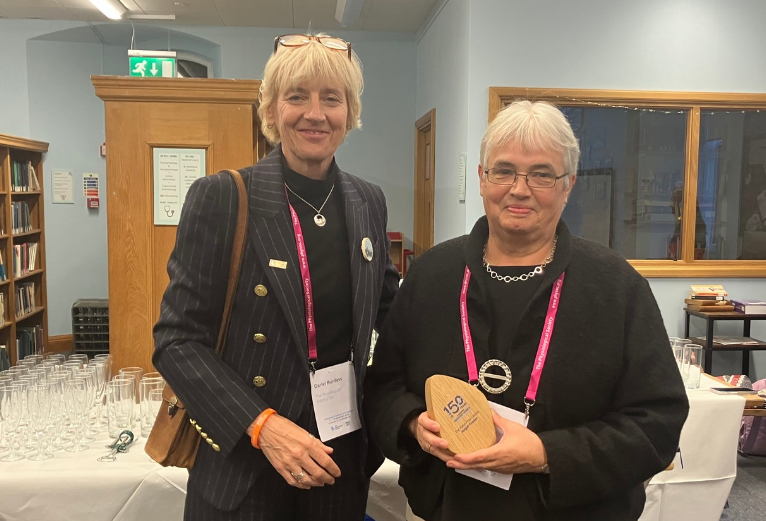
On Thursday 17 September, Abigail presented her Paton Prize Lecture, ‘Sir Jospeh Barcroft (1872-1947), pioneer of fetal and neonatal physiology’ at our ‘Celebrating Physiology in Cambridge’ event. Abigail took us through the history of fetal development research, as she described the life and work of Barcroft, who was the third Professor of Physiology at the University of Cambridge.
Barcroft began his career as an experimental physiologist, investigating saliva production, specifically its oxygen requirement and neural regulation, before studying physiological adaptations to hypoxia “by undertaking high-altitude expeditions and experimenting on himself in an air-tight glass chamber”. In the early 1930s, when Barcroft was in his 60s, he developed an interest in fetal physiology. Abigail explains that this marked the final phase of Barcroft’s research, for which he is best remembered.
‘Everest in utero’ is how Barcroft likened the fetus to an acclimatised highland mountaineer, comparing the low-oxygen environmental conditions in which fetuses normally develop with hypoxia at high altitude. “In his acute experiments on anaesthetised pregnant sheep, Barcroft measured placental function, fetal growth rates, fetal haemoglobin and oxygen carrying capacity, fetal oxygen consumption, fetal respiratory movements, fetal and placental blood flow and changes in the circulation and lungs at the time of birth,” says Abigail.
Professor Abigail Fowden delivered her Paton Prize Lecture on Sir Joseph Barcroft at the unveiling of two Society blue plaques in honour of the Nobel Prize winning physiologists, Sir Alan Lloyd Hodgkin (1914 –1998) and Sir Andrew Huxley (1917 –2012).