

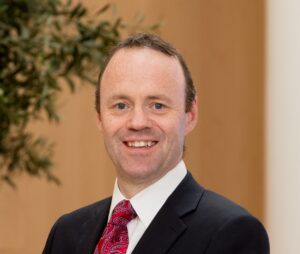
By Sean M. Roe
Centre for Biomedical Sciences Education, School of Medicine, Dentistry and Biomedical Science, Queens University Belfast.
Sean is a long time Physiological Society enthusiast, ever since being taken by Prof. Paul McLoughlin to present at his first Physiological Society Meeting in Cambridge in July 1994. Since then, he has spent over 29 joyful years in Queens University Belfast teaching Physiology to generations of Human Biology, Biomedical Science, Medicine, Dentistry, Nursing and Pharmacy Students. He has long been an enthusiast of the history of the discipline, being inspired by the work of Caoimhghin Breathneach (1923-2019) the noted medical history scholar from his Alma Mater (University College Dublin). This interest found an excellent outlet in Sean’s membership of the Society’s History and Archives Committee under Angus Brown’s capable chair. It has also resulted in his winning the Paton Prize Lecture in 2024, presenting on the subject of the Irish neurologist and Western Front battle medic Professor (Lieutenant Colonel) Gordon Morgan Holmes. He is delighted to take this opportunity to celebrate the subject’s long and storied history and namecheck some of his inspirations.
We spoke to Sean as part of our 150 voices of physiology series to talk about the rich narrative history of physiology and physiology heros
The times, they are a changin’; Taking your place in the evolving story of 150 years of physiology
While preparing with my student for the recent “Celebrating Physiology in Northern Ireland” event to mark the Physiological Society’s 150-year anniversary (Verhagen et. al. 2026), I was struck profoundly by how physiologic paradigms evolve historically. Seemingly archaic ideas need to be seen in the context of the times that produce them. The “70Kg man” idea is such a notion, excluding, as it does the wide diversity of human existence of all genders and races (Philips, 2023). It is comforting (and reassuring) to see that the society has been at the forefront of efforts to diversify and recognise women physiologists (Wray and Tansey, 2015) with Damian Bailey (Editor in Chief of Experimental Physiology) championing the recognition of female scientific leaders in general (Bailey, 2023) and Florence Buchanan in particular (Clark et. al., 2026).
In myriad other ways, the society, the subject and its history have a broad and rich narrative from which to draw the stories that give meaning to our discipline and our work. For enthusiasts of interdisciplinarity and the intersection between art and science, the very “Father” of physiology, Claude Bernard is a case in point; he started his career as a playwright, composing a 5-act play “Arthur de Bretagne” in 1834 before deciding instead to pursue a career in physiology and medicine. It strikes me that Bernards famous concept of the dynamic maintenance of a “milieu interieure” owes much to the sensibility of the theatre where “mise en scène” brings the words of a playwright to realisation on a stage (Murphy, 2022). My own investigation of the Irish physiologist and neurologist Gordon Morgan Holmes (Roe, 2025) leads to similar conclusions on interdisciplinarity, his achievements being predicated on non-silo’d thinking. Across his work, and often in the same article, Holmes demonstrated expertise variously in anatomy, physiology, neurology, pathology, clinical practice and visual art. As an Irish volunteer on the Western Front in 1915, his legacy speaks too to reconciliation and positive relationships between Ireland and the UK and is evidence of a profound shared history. Other notable heroic physiologists contributing crucially during the national emergency of wartime were Hodgkin and Huxley who turned their not inconsiderable talents to centimetric and gunlaying radar when it was all hands on deck during WWII (the Physiological Society, 2026). It seems that building rudimentary electronics to record potentials from giant squid axons was a transferable skill!
These historic examples only illustrate my particular areas of interest and so barely scrape the surface of the rich narrative that the history of physiology spins. I could have mentioned Banting and Best and their work on insulin, or how Sherrington’s work led to a profound understanding of vertebrate movement control. His Canadian student (Wilder Penfield) later developed ideas around the human motor homunculus in 1951, his remarkable surgical collaborations with Herbert Jasper inspired by his 1917 work in Sherrington’s lab with primates.
Adding to this, as a Learned Society, we are only now starting to appreciate the work of African, Central, South and Far Asian contributors to the discipline. No matter your specialist area, there will be a physiology hero to inspire and contextualise the work you’re doing. I would strongly recommend seeking out such a physiology hero and placing yourself as one with a long line of inspiring progenitors.
References
Bailey, D. M. (2023) ‘Mind and mend the gap: Women in physiology’, Physiology News, 129, pp. 10–12.
Clark, B. C., Bailey, D. M. and Ashcroft, F. M. (2026) ‘Finding Dr Florence Buchanan: The recovered face and fuller life story of a scientific legend’, Experimental Physiology, DOI: 10.1113/EP094202.
Murphy, P. (2022) ‘Claude Bernard, playwright, and the value of the dramatic arts for physiology education’, Physiology News, 128, p. 15. https://doi.org/10.36866/pn.128.15
Phillips, J.S., 2023. The not-so-average 70 kg man. BMJ, 383, p.p2404. doi:10.1136/bmj.p2404
Roe, S. M. (2025) ‘Paton Prize Lecture Winner 2024: Gordon Holmes and the Irish spirit of adventure: Lessons for modern thinkers’, Experimental Physiology, 110(4), pp. 511–520. doi: 10.1113/EP092192.
The Physiological Society. (2026). Celebrating two giants in physiology: Hodgkin and Huxley. https://www.physoc.org/news_article/celebrating-two-giants-in-physiology/ Accessed September 29th 2026
Verhagen, J., Burke Brady, L., de Almeida McLaughlin, M., McGahon, M., McMackin, R. and Roe, S., 2026. Busting the myth of 70Kg man through participation in an anthropomorphic data practical. Proc Physiol Soc, 71, p. C01.
Wray, S. and Tansey, T. (eds.) (2015) Women physiologists: Centenary celebrations and beyond. London: The Physiological Society