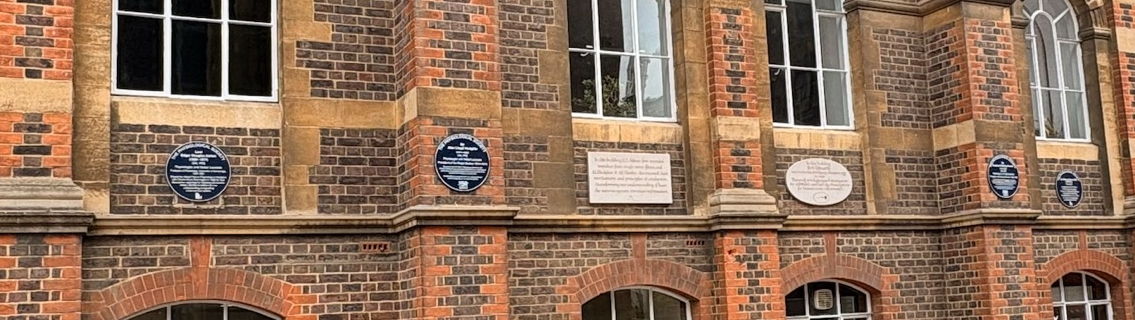
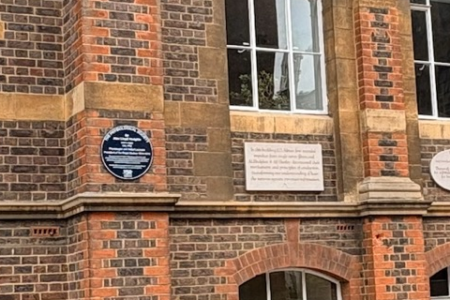
The Physiological Society honours Sir Alan Lloyd Hodgkin and Sir Andrew Huxley with blue plaque unveilings at the University of Cambridge.
“Hodgkin and Huxley were true giants of science of the order that rarely come along: they not only re-wrote the textbooks, they added an entirely new chapter,” says Professor Steve Edgley (University of Cambridge, UK). He presented the Society’s Paton Prize Lecture ‘Hodgkin and Huxley: Giants of science’ shortly before the grand unveiling of the two commemorative blue plaques for the Nobel Prize winning physiologists, Sir Alan Lloyd Hodgkin (1914 –1998) and Sir Andrew Huxley (1917 –2012).
On 17 – 18 September, we celebrated the remarkable talents and careers of physiologists; past, present, and future in our ‘Celebrating Physiology in Cambridge’, one of our special events for our 150th anniversary. “Their achievements stand out as a high point in science,” declares Professor Edgley. During his lecture, he reminded us of Hodgkin and Huxley’s aptitude and innovation. “It’s very easy to forget that their work was undertaken with very basic electronics with semiconductors only being invented around the time they were working. Much of their equipment was hand-built, by themselves.”
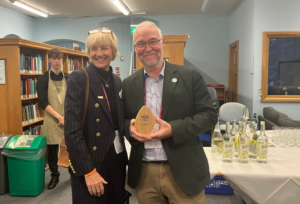
Dariel Burdass (Chief Executive of the Society) presented the Paton Prize to Professor Steve Edgley (University of Cambridge)
Studying nerve impulses and electrical signalling
The pair studied at Trinity College at the University of Cambridge. Their collaboration began in 1938, when Hodgkin was working in the Physiology Department and Huxley was an undergraduate student. Their work was interrupted at the outbreak of World War II in 1939. During which, they both applied their physics backgrounds to carry out military research. Hodgkin worked in Aviation Medicine and the development of the centimetric radar. Huxley served with the British Anti-Aircraft Command working on radar control and then with the Admiralty on naval gunnery.
After the war ended in 1945, both returned to Cambridge, Hodgkin resumed his teaching post, and Huxley took up a research fellowship post. They continued their work together focusing on neuronal and electrophysiology. Most of their experiments involved giant axons of the Atlantic squid at the Marine Biological Association Laboratory in Plymouth using the voltage clamp technique. This led to their discovery of the basis of excitation and propagation of nerve impulses and what they termed the ‘overshoot’ of the nerve action potential, which is the brief period during nerve cell activity when membrane polarity reverses. Their analysis and mathematical description of the basis of the nerve impulse and its propagation earned them the Nobel Prize in Physiology or Medicine in 1963, which they shared with Sir John Carew Eccles.
This research laid the foundations for our understanding of electrical signalling in the nervous system. Professor Edgley tells us that Hodgkin and Huxley suggested that their findings “be regarded as a first approximation which needs to be refined and extended in many ways in the search for the actual mechanism”. Professor Edgley also highlights that they made significant achievements in their own personal pursuits. Hodgkin focused on the responses of photoreceptors to light, while Huxley was interested in muscle contraction and force generation. Both became Masters of Trinity College Cambridge.
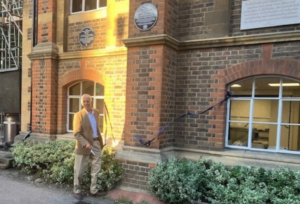
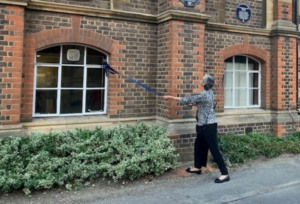
Husband and wife Professor Bill Harris and Professor Christine Holt unveiled the blue plaques for Hodgkin and Huxley.
The legacy of Hodgkin and Huxley
At the gathering in Cambridge, the plaques were unveiled by two eminent neuroscientists; Professor Bill Harris unveiled Hodgkin’s plaque and Professor Christine Holt unveiled Huxley’s plaque. Both plaques are mounted on the wall of the Department of Physiology, Development and Neuroscience building, placed near the blue plaques for Sir Michael Foster and Lord Edgar Adrian.
Professor William (Bill) Colledge, Head of the Department of Physiology, Development and Neuroscience at University of Cambridge, says:
“It’s an honour for my department to be part of the celebrations for the 150th year anniversary of the Physiological Society. The Physiological Laboratory in Cambridge has housed a number of eminent physiologists and Nobel laureates who have made seminal discoveries in Physiology. I would like to thank the Physiological Society for their recognition of some of these individuals by commemorating them with these blue plaques. The Physiological Society has a vital and important role in supporting world-class physiological research and advocacy for this important discipline and long may this continue.”
Across the two days, historic and scientific talks paid tribute to the two influential physiologists. Angus Brown (University of Nottingham, UK) shared his appreciation of Hodgkin and Huxley. This was followed by the insights presented by Dr James Fraser (University of Cambridge, UK) and Dr Claire Martin (University of Cambridge and Royal Papworth Hospital, Cambridge, UK) in their talks ‘Waveform-derived length and time constants for propagating action potentials’ and ‘From the physiology department to the clinic: Electrophysiology research in a clinical setting’, respectively.
The Cambridge event served as a reminder of the discoveries that have shaped our understanding of the body, and the community driving physiology forward. May the prestigious wall of blue plaques inspire students and researchers as they forge their own investigations in the footsteps of these giants in physiology.
References
Prize Lecture Memoria – Alan Hodgkin (https://www.physoc.org/blog/prize-lecture-memoria-alan-hodgkin/) Accessed in September 2026.
Prize Lecture Memoria – Andrew Huxley (https://www.physoc.org/blog/prize-lecture-memoria-andrew-huxley/) Accessed in September 2026.