
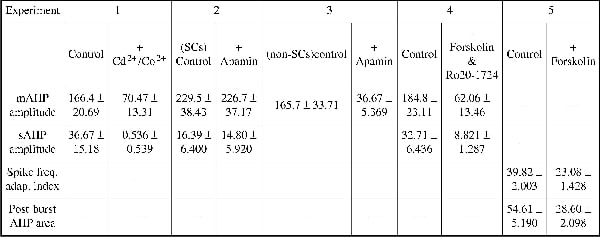
Spike-frequency adaptation (SFA) controls neuronal excitability in cortical neurons and is attributed to Ca2+-dependent K+ (KCa) currents which underlie most of the medium and slow afterhyperpolarizations (mAHP and sAHP) [1]. The entorhinal cortex (EC), part of the medial temporal lobe, serves as a ‘cross-road’ between the cortex and the hippocampus and is implicated in memory and learning [2]. Recent studies of cortical cells show that a reduction in SFA and post-burst AHP currents correlates with enhanced learning capability [3]. Also, medial EC (MEC) layer II stellate cells (SCs) provide one of the most prominent cortical inputs to the hippocampus [4]. Therefore, we investigated how SFA and the mAHP and sAHP are modulated in these cells. Recordings were obtained under the whole-cell patch clamp configuration in a rat in vitro slice preparation. The internal solution contained (mM): 120 KMeSO4, 10 Hepes, 0.2 EGTA, 20 KCl, 2 MgCl2, 7 diTrisPhCr, 4 Na2ATP and .3 TrisGTP. The external solution contained 126 NaCl, 2.5 KCl, 2 CaCl2, 2 MgCl2, 25 NaHCO3 and 10 glucose. Kynurenic acid (2 mM) and picrotoxin (100 μM) were used to block synaptic transmission. For statistics, we used paired Student’s t tests. Linopirdine (20 μM) and ZD-7288 (30 μM) were used to block M and H currents, respectively. Ca2+-dependent (Ca2+-dep.) currents contributing to the mAHP and sAHP were induced by applying a 100 ms step depolarization to +20 mV from a holding potential of -50 mV. The Ca2+-dependent currents (n = 9; Table 1, Expt 1) consisted of a medium (Ca2+-dep. mAHP) and a slow component (Ca2+-dep. sAHP) in SCs. Apamin, a blocker of SK channels, mediates the Ca2+-dependent K+ component of the mAHP in cortical neurons [1]. However, we found that whereas the mAHP of MEC layer II non-SCs could be inhibited by 300 nM apamin (p = 0.0194; n = 3), that of MEC Layer II SCs was not affected (300 nM; n = 9; p = 0.6982). Stimulation of cAMP production has been shown to suppress sAHP in cortical neurons, without affecting the mAHP [1]. Application of forskolin (50 μM) and Ro20-1724 (200 μM), which stimulates cAMP production, suppressed both the mAHP (p = 0.0028) and the sAHP (p = 0.0059; n = 8) in SCs. To invoke repetitive firing, we applied 6 s 150 pA pulses. Application of forskolin (25 μM) decreased the SFA index (p = 0.0012) and post-burst AHP area (p = 0.0070; n = 4). We conclude that the Ca2+-dep. mAHP is not mediated by SK channels in SCs. Also, the Ca2+-dep. mAHP, sAHP and SFA are modulated by the cAMP pathway in SCs.
University College London 2006 (2006) Proc Physiol Soc 3, C103
Research Symposium: Control of spike frequency adaptation in medial entorhinal cortex layer II stellate cells
Farhan Khawaja1, Angel Alonso1, Charles W Bourque1
1. Neurology and Neurosurgery, Montreal Neurological Institute, McGill University, Montreal, QC, Canada.
View other abstracts by:
Where applicable, experiments conform with Society ethical requirements.