Introduction:
Obesity is a chronic, multifactorial disease typically associated with hyperleptinemia and leptin resistance, whereby leptin fails to promote its anticipated effects1. Efforts to better understand and define leptin resistance have largely focused on dissecting the mechanisms behind central leptin resistance. Recent studies show that leptin activates the sympathetic neurons innervating adipose tissue, promoting lipolysis2 and thermogenesis3 via neuronally released norepinephrine. Hence, the restoration of leptin sensitivity in adipose tissue could be a therapeutic target for obesity. However, the cellular and molecular players coordinating leptin and sympathetic signalling in adipose tissue remain poorly understood.
Aims/Objectives:
This study aims to identify and characterise cellular mediators coordinating leptin and sympathetic signalling in adipose tissue, and to determine their role in energy homeostasis and obesity.
Methods:
Single-cell RNA sequencing was performed on murine sympathetic ganglia (n = 20 mice) to identify novel cell populations. Conditional knockout mice targeting Adrb2 in Lepr⁺ cells (Adrb2KO) were generated for loss-of-function studies, with littermate controls (LeprCre and Adrb2fl/fl).
Metabolic phenotyping included body weight and food intake (n = 15-20 per group), energy expenditure (n = 7-10 per group), and thermogenesis (n = 5-7 per group). Histological and apoptosis analyses were conducted in adipose-associated ganglia and sympathetic nerve fibres from high-fat diet-fed obese mice (n = 5 per group). Human genetic association analyses were performed in a European cohort (n = 346,177 individuals) from the UK Biobank.
Data are presented as mean ± SEM. Statistical analyses were performed using unpaired two-tailed Student’s t-tests or one- or two-way ANOVA with appropriate post hoc corrections, as applicable. Statistical significance was defined as p < 0.05.
All animal procedures were conducted in accordance with the UK Animals (Scientific Procedures) Act 1986 and approved by the institutional Animal Welfare and Ethical Review Body. Human genetic analyses were performed on de-identified data from approved cohorts with relevant ethics committee approval.
Results:
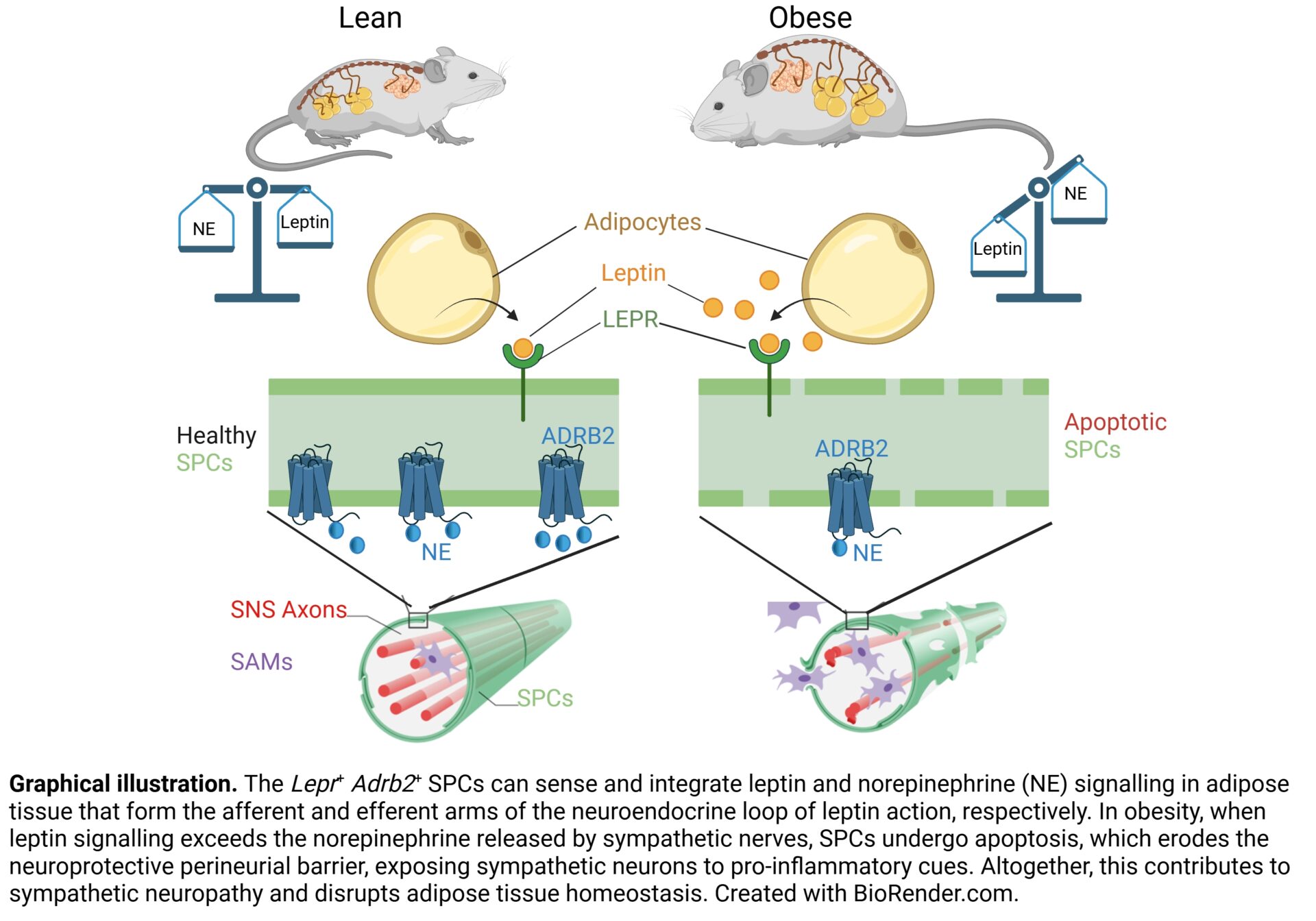
Using single-cell RNA sequencing on murine sympathetic ganglia, we identified a unique population of perineurial cells expressing both the leptin receptor (Lepr) and the β2 adrenergic receptor (Adrb2)4. Sympathetic Perineurial Cells (SPCs) form a barrier surrounding sympathetic ganglia and nerve bundles in adipose tissue and display molecular features resembling endothelial cells. Conditional knockout of Adrb2 in Lepr+ SPCs predisposes mice to obesity by lowering energy expenditure and thermogenic activity without affecting food intake. Notably, we found that obesity-driven hyperleptinemia causes apoptosis in SPCs, leading to a significant erosion of the perineurial barrier and concomitant sympathetic neuropathy. We further show that this deleterious effect can be reversed by partial reduction of leptin or by β2 adrenergic receptor agonism. Supporting translational relevance, we confirmed the presence of LEPR+ ADRB2+ SPCs in human sympathetic ganglia. We also observed a synergistic effect of highly common polymorphisms in LEPR and ADRB2 on the risk of increased BMI in a large European population.
Conclusion:
These findings identify SPCs as a critical neuroendocrine interface integrating leptin and sympathetic signalling in adipose tissue and support a revised model of the leptin set point beyond central appetite regulation.