Introduction: Doxorubicin (DOX) is a potent chemotherapeutic agent whose clinical utility is severely limited by dose-dependent cardio- and nephrotoxicity. Betaine, a methyl donor and major renal osmolyte, has been suggested to maintain cardiovascular homeostasis and improve renal function through antioxidant and potential diuretic mechanisms[1, 2].
Aims: This study evaluated the protective effects of betaine against DOX-induced injury in heart and kidney tissues by assessing hemodynamic, biochemical, and molecular parameters.
Methods: Male Sprague-Dawley rats (n=36) were randomized into four groups: Control (tap water; n= 8); Betaine (0.5% solution in water, n= 8); DOX (i.p. injections, cumulative dose 15 mg/kg bw, n=10); and DOX+Betaine (n=10). After eight weeks, 24-hour water and food balance were evaluated in metabolic cages. Subsequently, echocardiography and hemodynamic recordings were performed under urethane anaesthesia (1.5 g/kg bw i.p.). Plasma NT-proBNP and urinary KIM-1 were measured via ELISA. Biochemical parameters including proteinuria were determined using a Cobas 6000 analyzer. Antioxidant enzymes (catalase, SOD1) were quantified by Western blot in the heart, renal cortex, and medulla. Data were analyzed via ANOVA with Tukey’s or Kruskal-Wallis with Dunn’s post-hoc tests (p < 0.05). All procedures were approved by the Local Ethics Committee and accorded with international guidelines and legislation.
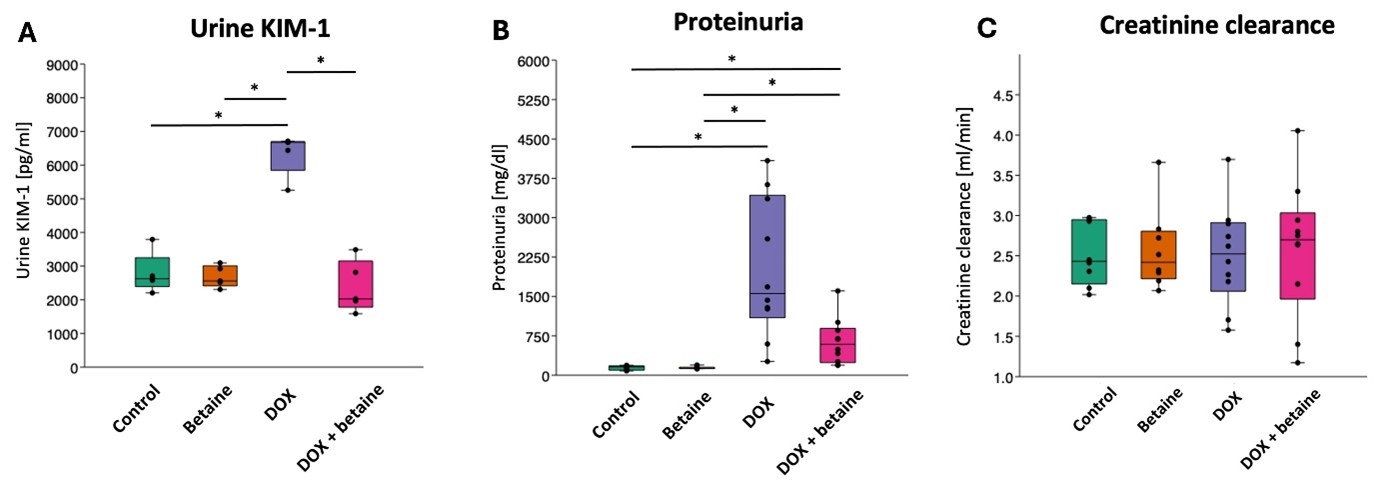
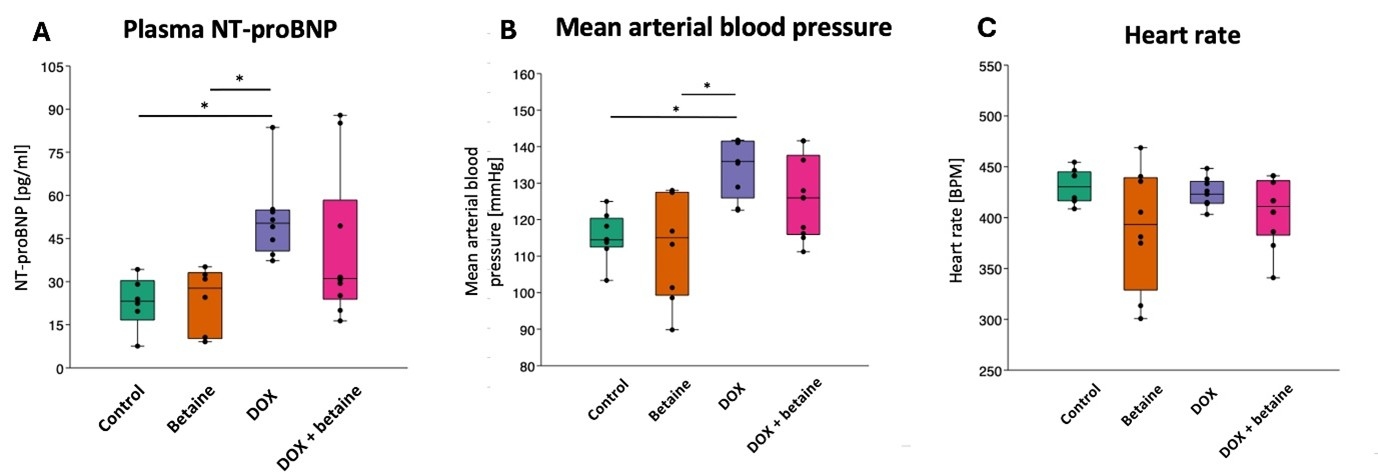
Results: DOX administration significantly increased mean arterial blood pressure (MABP) (DOX: 134.6±2.6 vs Control: 115.3±2.3 mmHg; p < 0.001) and plasma NT-proBNP levels (51.8±5.1 vs 22.8±3.7 pg/ml; p = 0.009). Renal damage was evidenced by elevated urinary KIM-1 (6352±279 vs 2781±597 pg/ml; p < 0.001) and marked proteinuria (2018.9±1320 vs 144.9±41.3 mg/dl, p < 0.001). Histopathological analysis confirmed morphological damage in both cardiac and renal tissues. Betaine supplementation significantly attenuated proteinuria (639.7±439.6 mg/dl, p < 0.05 vs DOX) and urinary KIM-1 levels (2376±342 pg/ml, p < 0.05 vs DOX). It also partially mitigated the rise in MABP (125.9±3.5 mmHg) and NT-proBNP (38.3±7.7 pg/ml), while improving tissue morphology. Notably, betaine did not significantly alter urine excretion rates or the expression of antioxidant enzymes (SOD1, catalase) in the heart or kidney. Data are expressed in means±SE.
Conclusions: Dietary betaine provides significant protection against DOX-induced cardiorenal injury. These protective effects appear to be independent of antioxidant enzyme modulation or diuretic actions, suggesting alternative mechanisms of action. These findings support the investigation of betaine as a non-pharmacological dietary strategy to mitigate chemotherapy-induced toxicity.
Figure 1. Box plots showing biochemical markers of kidney damage in experimental groups. * p < 0.05 by ANOVA with Tukey’s post-hoc test or by Kruskal-Wallis with Dunn’s post-hoc test.
Figure 2. Box plots showing NT pro-BNP and hemodynamic parameters in experimental groups. * p < 0.05 by ANOVA with Tukey’s post-hoc test or by Kruskal-Wallis with Dunn’s post-hoc test.