Introduction: Redundancy within cardiorespiratory networks is fundamental to maintaining physiological stability under varying conditions. Multiple overlapping control mechanisms ensure that critical functions, such as oxygen delivery, are preserved even when one pathway is compromised. This redundancy enhances system robustness, allowing the body to adapt to stressors such as hypoxia while minimising the risk of failure. This is particularly important in critical illnesses such as sepsis, where impaired physiological network connectivity and sequential organ failure can lead to mortality. Recent advances in network physiology have led to the development of methods for the non-invasive assessment of cardiorespiratory network dynamics. These methods have the potential to evaluate the extent of redundant pathways within the control system and their association with survival in critically ill patients.
Aims: This study aims to use non-invasive methods to assess the extent of redundant pathways involved in cardiorespiratory regulation using the concept of transfer entropy.
Methods: This retrospective study used the Medical Information Mart for Intensive Care III Clinical Database (MIMIC-III), including patients who met Sepsis-3 criteria on admission and had at least 30 minutes of continuous heart rate (HR), respiratory rate (RR), and oxygen saturation (SpO₂) time-series data (n=164). Recording and use of data from the MIMIC-III dataset were approved by the Institutional Review Boards of the participating institutions (IRB Protocol Nos. 2001P001699/14 and 0403000206). This study used the concept of transfer entropy (TE) to quantify information flow among HR, RR, and SpO₂ in critically ill patients with sepsis (1). To assess redundancy, conditional TE was used to determine whether a relationship is truly direct or partly explained by shared dependence on another signal. For example, it was used to evaluate whether TE (HR→RR) reflects a direct link or is influenced by SpO₂, i.e., TE (HR→RR | SpO₂).
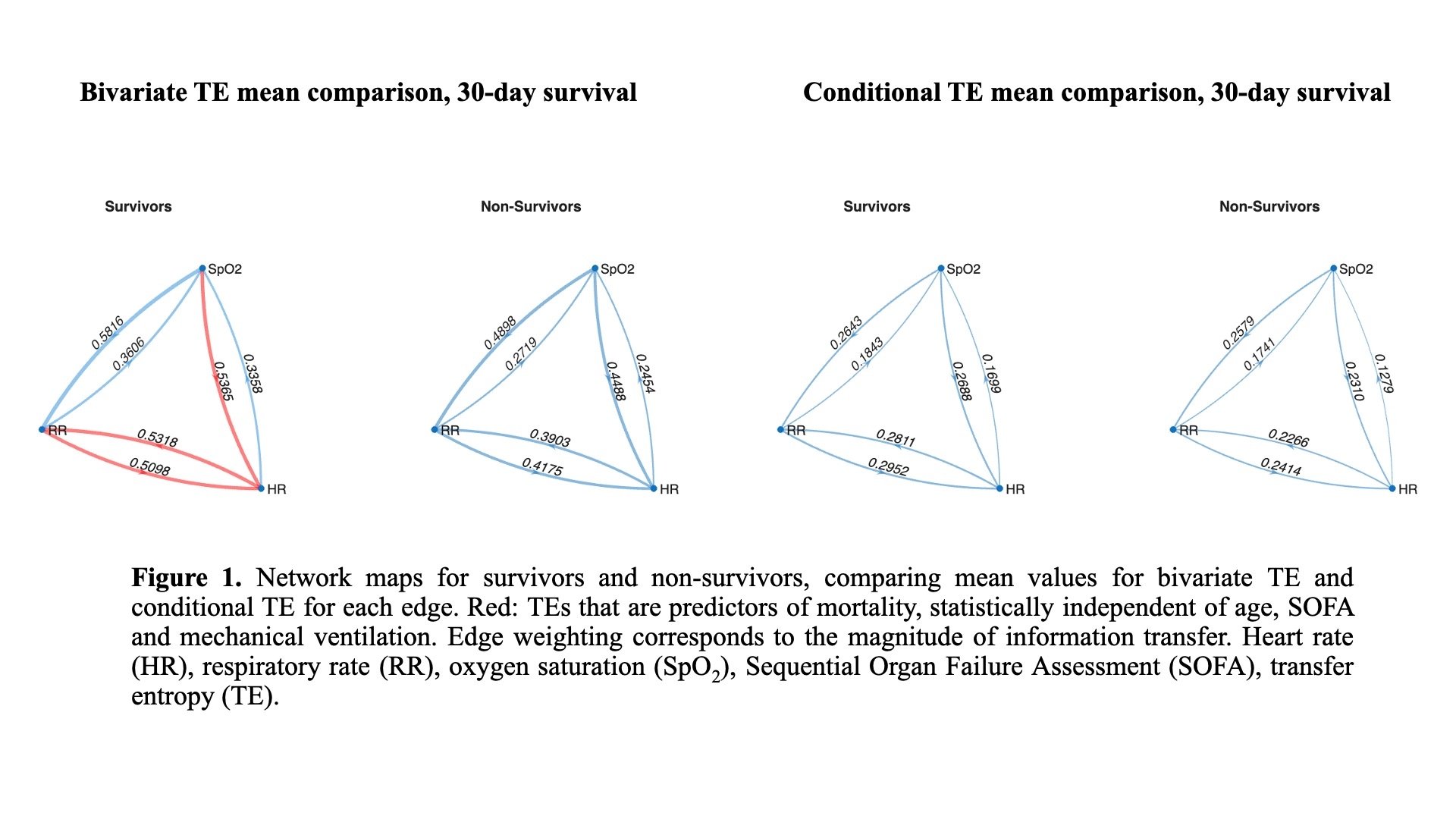
Results: Overall, 130 of 164 patients survived at 30-day follow-up. Non-survivors exhibited reduced information transfer (bivariate TE) between physiological variables (p < 0.05). Cox regression analysis demonstrated statistical independence for TE (SpO₂→HR), TE (RR→HR), and TE (HR→RR) after adjustment for potential confounders (age, severity-of-disease score, and mechanical ventilation) (P<0.05). Increases in these values were associated with reduced mortality (Figure 1). Bivariate TE showed higher mean values than conditional TE, indicating the presence of redundancy within the network (Figure 1). For conditional TE, the prognostic value was less prominent than that of bivariate TE, suggesting that the presence of redundancy in the network may play a protective role in critically ill patients with sepsis.
Conclusion: Physiological network mapping using transfer entropy has the potential to noninvasively measure meaningful interactions among physiological systems, with conditional TE highlighting higher-order interactions and network redundancy that are not captured by bivariate analysis alone.