
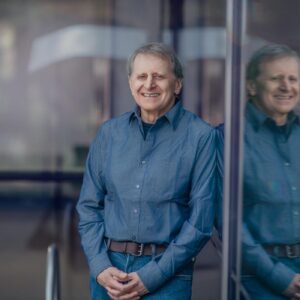
By Stephen G. Waxman, MD, PhD
Bridget Marie Flaherty Professor of Neurology,
Neuroscience, and Pharmacology;
Yale University School of Medicine
Stephen Waxman is the Bridget Flaherty Professor of Neurology, Neuroscience and Pharmacology at Yale University, where he served as Chairman of Neurology from 1986 until 2009. He founded Yale’s Neuroscience & Regeneration Research Center and has been its director since 1988.
Dr Waxman’s early papers in Science, PNAS and Nature defined the ion channel architecture of nerve fibers, and demonstrated its importance for axonal conduction. He discovered the sodium channel plasticity that supports recovery of impulse conduction in demyelinated axons, thereby explaining the molecular basis for remissions in Multiple Sclerosis.
Dr Waxman has been a pioneer in unraveling the roles of sodium and potassium channels in pain signaling, and his work has led to new therapies. Using molecular genetics, stem-cell models, computation methods and biophysics, he made a molecule-to-man translational leap from laboratory to humans that demonstrated the roles of sodium channels Nav1.7, Nav1.8 and Nav1.9 in human pain. He used atomic-level modeling to advance pharmacogenomics in a study, accompanied by a JAMA editorial stating “there are few examples in clinical medicine where molecular reasoning has been rewarded with comparable success”. He is now pinpointing “pain resilience” genes. New non-addictive pain medications, based largely on his work, are in or headed toward clinical trials, and the first has achieved FDA approval.
Stephen is the 2026 winner of The Sharpey-Schafer Prize Lecture for Translational Physiologists. We spoke to Stephen as part of our 150 Voices of Physiology series.
Huxley’s Science Fiction: From the Squid Giant Axon to Real World Medicine
It’s a privilege to be asked to write this perspective. Throughout my career I have been propelled by the question of how neurons work and by my fascination with the beauty of the nervous system, not just at the circuit and cell level, but also in terms of its elegant molecular architecture. I’ve watched, and hopefully contributed to, the transformation of neurology into a more therapeutic discipline. From my point of view, that transformation has been inspired by mechanistic advances: how do cells in the nervous system work? Why do they work improperly in various disease states? And, what can we do about it? British physiologists have of course been pioneers in pursuit of these questions, and the Physiological Society lies at the center of this effort.
In preparing the 2026 Sharpey-Schafer Prize Lecture for Translational Physiologists, I begin by showing the now-classical Hodgkin-Huxley schema of action potential electrogenesis (J.Physiol. 1952). This prescient work – carried out in the squid giant axon in the late 1940s before invention of the modern microelectrode, without access to computers or molecular biology – remains a bastion of neuroscience. In 2023 I was invited by the New England Journal of Medicine – a leading clinical journal – to write an article on “The Science Behind the Clinical Trial,” as the first non-opioid pain medication (a medication targeting a “peripheral sodium channel”) was announced. NEJM allowed me to begin that article by reproducing the classical Hodgkin-Huxley diagram, then tracing the arc from laboratory bench to clinic. In my Sharpey-Schafer Lecture, I outline the remarkable trajectory from the squid giant axon 1952 through the world of modern neuroscience, to the development of an entirely new class of non-addictive pain medicines.
From my earliest recollections, I always wanted to be a scientist. Although my parents encouraged me, I grew up in a family where few had the opportunity to go to college or university. Those who did tended to go to the nearest local college while living at home. It was only at the urging of a high school guidance counselor that I applied to Harvard (it had not been part of my conscious universe). It opened up a new world for me. Among my professors were JD Watson and Keith Porter, and as a student I met Eric Kandel when he visited to give a talk at the Harvard Biolabs. I also spent time hanging out in the lab of Pat Wall who, at that time, was professor of biology at MIT, a mile down Commonwealth Avenue from Harvard.
My interest in axons was born when I worked as a student in the laboratory of J.D. Robertson, who had uncovered the bilayer architecture of the ‘unit membrane’ and discovered the spiral configuration of the myelin sheath. The lab was small by today’s standards, but rich in talent – Nick Spitzer and John Heuser, each a few years ahead of me, were working there as Harvard medical students. “JD” taught us more than science. He and his wife Dotie hosted innumerable parties and picnics where everyone from his lab – students and technician as well as senior staff – relaxed, danced, enjoyed stories of his upbringing in Mississippi, and shared his favorite bourbon. At one of these events, his younger daughters suggested that I “ask Daddy to send you to UCL”. Triggered by that suggestion, I asked him to arrange for me to spend six months at UCL. It was exhilarating. I worked in the lab of Robertson’s friend JZ Young (discoverer of the squid giant axon). Around the corner, Semir Zeki was uncovering the complexity of multiple visual cortices. Down a nearby corridor, Andrew Huxley was moving muscle physiology ahead. Upstairs, Bernard Katz and his team were unraveling mechanisms of synaptic transmission. The word “neuroscience” had not been invented. But here it was, all in one building.
After finishing college I knew I wanted to do biomedical research with a focus on neuroscience. I applied to, and was accepted at, Harvard Medical School, but they did not yet have a Medical Scientist (MD-PhD) Training Program. Albert Einstein College of Medicine had just launched its MSTP, generously funded by the NIH, and I went there. I never regretted that decision; Einstein’s faculty included Al Gilman and Murdoch Ritchie (Pharmacology), Harry Eagle (Cell Biology), Alex Novikoff (Pathology) and countless other stars and, even as students, we got to spend time with them. I chose to work with Dom Purpura and Mike Bennett. Mike performed at Olympic level as a physiologist, and was a demanding mentor. My first papers with him (Kriebel et al, Science 1969; Waxman et al, J.Cell Biol, 1972; Waxman and Bennett, Nature New Biology, 1972, accompanied by an editorial by Andrew Huxley) reinforced my interest in neurons and their constituent electrogenisome as beautiful computational machines. I was fascinated by the elegance of biological architecture – structure supports function, every cell and every molecule shaped for a specific role and in its proper place.
I returned to UCL in about 1970 when, supported by a grant from the Epilepsy Foundation, I had the privilege of working with Pat Wall. His laboratory was small – one technician, one postdoc, and one student – and I got to work side-by-side with this giant as we studied ectopic impulse generation in injured nerve fibers. That work, of course, was largely observational. A decade later, based on intra-axonal recordings using sharp electrodes both in animal models (Kocsis and Waxman, Nature 1983) and in the axons of humans with painful neuropathy (Progr. Brain Res, 1987), we pinpointed a “slowly inactivating sodium channel” (which turned out, a decade later, to be Nav1.8) as a driver of peripheral pain signaling. That work, as described below, was subsequently propelled by the ‘molecular revolution’.
Early in my career, I was interested in grand philosophical questions, for example, of how the brain’s 100 billion neurons collaborate to create consciousness and free will. I was thrilled to win a prize (The NIH Trygve Tuve Award) for my paper (IEEE Transactions on Systems Science and Cybernetics) as an MD-PhD student on how lateral inhibition within cortical circuits might contribute to cognition. But I came to the conclusion that definitive explanations of these big questions were at least decades away and that for me, reductionist science was more interesting. I decided to concentrate on philosophically trivial, but solvable, problems like the biological basis for remissions in MS (NEJM 1982, again an ion channel mechanism, involving the non-uniform distribution of sodium channels in myelinated axons, and plasticity of channel expression in demyelinated axons) and identification of ion channel drivers of pain that could serve as therapeutic targets (PNAS 2025). I share this vignette with my trainees and encourage them to work at the level of complexity that fits them best.
My training in clinical neurology, at the Harvard Neurological Unit, Boston City Hospital, taught me to be a doctor. It also provided a scaffold of human biology and human disease on which to hang my cellular and molecular work. My clinical chief, Norman Geschwind, had trained at the Institute of Neurology, Queen Square (now part of UCL), and ‘visit rounds’ were made by his predecessor Derek Denny-Brown, who had worked on motor physiology with Sherrington. I was fortunate to train in this unique clinical department, where meticulous clinical observation and medical judgement, while essential in clinical practice, were always coupled with questions about mechanism.
Although I was trained as a clinician and keenly interested in societal goals – can we use science to cure human disease – a central motif in my research was (and still is) that solid, incisive science is even more important than disease relevance. The motto “Strong Science First”, which I think was inspired by my mentors, is one that I have passed on to many trainees.
In the 1980s and 90s and thereafter, as the ‘molecular revolution’ rolled in, I had the privilege of using molecular genetics, IPSC modeling, and powerful computational methods like dynamic clamp to identify and unwrap the complex functional roles of “peripheral sodium channels”. These channels, Nav1.7, Nav1.8 and Nav1.9, act as molecular drivers of pain signaling. The first peripheral sodium channel blocker has now been approved as a non-opioid, non-addictive pain medication (NEJM, 2023). It is only partly efficacious and we are currently dissecting the electrogenisome of pain-signaling neurons at high resolution with the aim of more completely understanding their electrogenic architecture, so that we can design a more efficacious next-generation therapy.
Throughout my career I have been fortunate in working with many stellar colleagues, collaborators and trainees; too many to list, but they can be found in a PubMed search of my papers. I owe them an immense debt. They have contributed immeasurably to my scientific output and, in many cases, they have become good friends.
It’s a challenging time for science, with tight funding and decreasing trust in academic institutions and research. I have been asked, by non-scientist friends, if I would become a scientist if starting my career again. My response is almost reflexic: Yes. Science now is more important than ever. Science can Matter. And, despite the challenges, Science is an incredibly rewarding pursuit.