
Read about the team of nerves, muscles and structures that control a process many of us might take for granted, swallowing. Hadeel Mohmmed, a second-year biomedical science student, take us through the sequence of events from mouth to the oesophagus.

Hadeel Mohmmed, second-year biomedical science student
Have you ever stopped to think about what really happens when you swallow? It feels entirely automatic, yet behind this simple action lies a highly coordinated system involving the mouth, pharynx, and upper oesophagus. Although we perform this movement dozens of times a day, we rarely appreciate the complexity of the neural and muscular control that makes it possible.
My growing interest in craniofacial physiology and the pharyngeal phase of swallowing, in particular the oral cavity, has made me realise how much activities occur beneath the surface of what we often take for granted. While I was initially drawn to dentistry and the structural anatomy of the jaw and face, I became increasingly curious about how these systems function in real time.
The hidden complexity of swallowing
From a dental point of view, one of the most striking facts is this: the oral cavity is not just a place for chewing. It is the starting point of a highly coordinated system that makes safe swallowing possible.
Every bite we take depends on smooth teamwork between the teeth, tongue, and muscles. These structures do not work alone. They pass control forward to the pharynx and then to the upper esophageal sphincter. Most of the time, we never notice this switch. But it happens with precision every time we eat or drink.
Swallowing, or deglutition, is far more complex than it seems. It involves over 30 nerves and muscles working in a carefully timed sequence. The goal is simple: move food from the mouth to the stomach while keeping the airway safe.
Chewing it over
The process begins in the mouth. During chewing, strong mastication muscles break food into smaller pieces. These include the masseter, temporalis, and pterygoid muscles. All are controlled by the mandibular branch of the trigeminal nerve (CN V3).
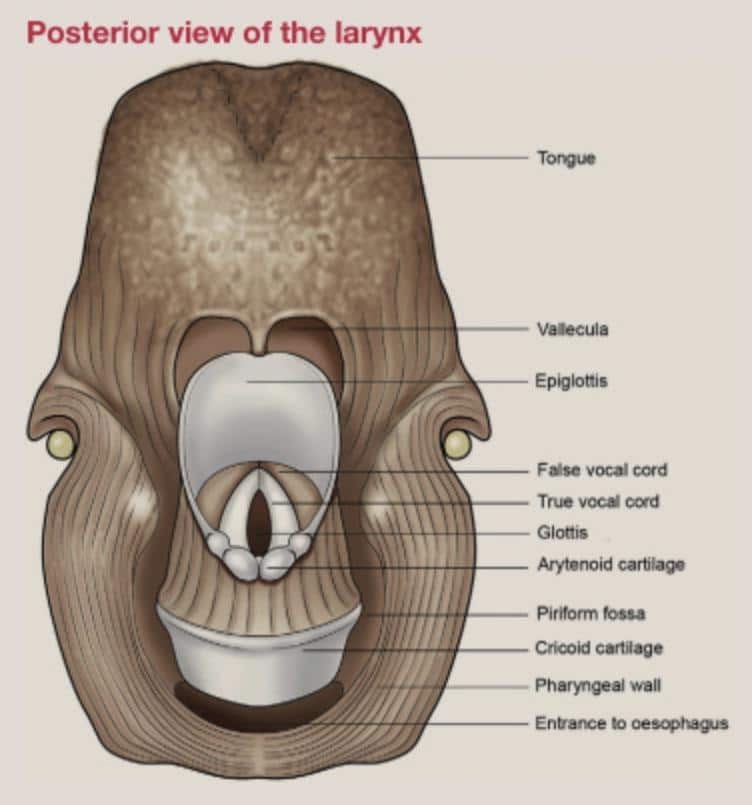
At the same time, the oral cavity is not passive. It actively prepares food for swallowing. Saliva mixes with the food, then compresses food particles and binds them together into a single cohesive bolus. The tongue demonstrated in Figure 1 plays a key role here. Muscles such as the genioglossus, hyoglossus, and styloglossus (controlled by CN XII), along with the palatoglossus (CN X), shape and move the bolus.
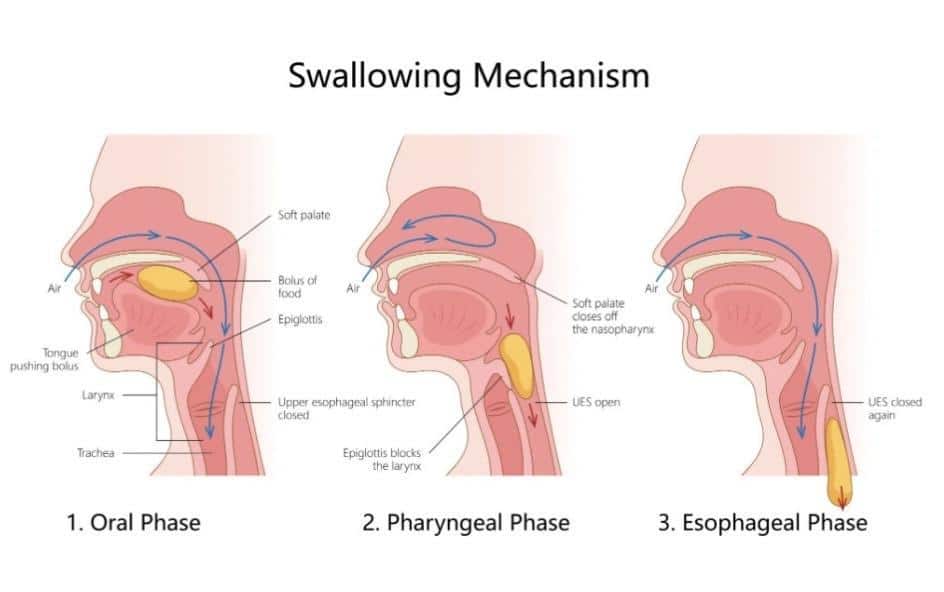
When the bolus is ready, the tongue pushes it towards the back of the mouth. The faucial pillars mark the transition between the oral cavity and the pharynx. This is a key turning point in swallowing. Here, voluntary control begins to blend with reflex actions shown in Figure 2.
Safety first
If tongue movement is weak or uncoordinated, swallowing can become difficult. This condition is known as ‘dysphagia’, and it can affect the quality of life.
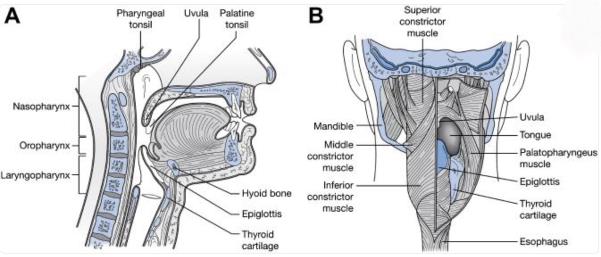
Once the bolus enters the pharynx, a new group of muscles takes over. The pharyngeal constrictor muscles illustrated in Figure 3 (superior, middle, and inferior), controlled mainly by the vagus nerve (CN X), help guide the food downward.
Other muscles such as the stylopharyngeus (CN IX), salpingopharyngeus (CN X), and palatopharyngeus (CN X) help lift and shorten the pharynx. This movement helps push the bolus safely towards the oesophagus.
At the same time, the suprahyoid and infrahyoid muscles stabilise and elevate the hyoid bone. This is essential for protecting the airway during swallowing.
Open up
At the lower end of the pharynx is the upper oesophageal sphincter (UES), also called the inferior pharyngeal sphincter. This is a tight, high-pressure zone. It stays closed most of the time to prevent air from entering the oesophagus and to stop food from coming back up.
The cricopharyngeus muscle is the main muscle that controls this opening. When it relaxes at the right moment, the bolus can pass into the oesophagus. In this way, the UES acts like a gate, ensuring one-way movement of food.
Good oral health and swallowing function
What makes swallowing so fascinating is how many systems work together without pause. Different regions of the mouth, throat, and neck act as one continuous unit.
The oral cavity does not only help with chewing. It also starts the swallowing process. When oral health is poor, swallowing can be affected. For example, oral thrush, caused by oral candidiasis, can spread and make swallowing uncomfortable or difficult. In more severe cases, this can reduce food intake and lead to weight loss.
Denture care is also important. Poorly cleaned dentures can lead to denture stomatitis and increase the risk of fungal infection. Patients are advised to clean dentures daily and remove them at night to reduce microbial growth. In some cases, treatment includes antifungal medication; regular oral checks are especially important in at-risk patients, such as those with cancer or HIV. Early detection can prevent complications and improve swallowing function and oral health.
References
Barranca-Enríquez, A., & Romo-González, T. (2022). Your health is in your mouth: A comprehensive view to promote general wellness. Frontiers in Oral Health, 3. https://pubmed.ncbi.nlm.nih.gov/36186536/
Basit, H., Eovaldi, B. J., & Siccardi, M. A. (2023). Anatomy, Head and Neck, Mastication Muscles. PubMed. https://www.ncbi.nlm.nih.gov/books/NBK541027/
Bui, T., & M Das, J. (2020). Anatomy, Head and Neck, Pharyngeal Muscles. PubMed. https://www.ncbi.nlm.nih.gov/books/NBK551654/
Chiara Cecchin-Albertoni, Olivier Deny, Valérie Planat-Bénard, Christophe Guissard, Paupert, J., Frédéric Vaysse, Marty, M., Casteilla, L., Monsarrat, P., & Philippe Kémoun. (2024). The oral organ: a new vision of mouth as a whole for a gerophysiological approach to healthy aging. Ageing Research Reviews, 99, 102360–102360. https://doi.org/10.1016/j.arr.2024.102360
Dotiwala, A. K., & Samra, N. S. (2020). Anatomy, Head and Neck, Tongue. PubMed. https://www.ncbi.nlm.nih.gov/books/NBK507782/
Garcia-Cuesta, C., Sarrion-Perez, MG., & Bagan, JV. (2014). Current treatment of oral candidiasis: A literature review. Journal of Clinical and Experimental Dentistry, 6(5), e576–e582. https://doi.org/10.4317/jced.51798
Information, N. C. for B., Pike, U. S. N. L. of M. 8600 R., MD, B., & Usa, 20894. (2019). Oral thrush: Overview. Institute for Quality and Efficiency in Health Care. https://www.ncbi.nlm.nih.gov/books/NBK367586/
Kamrani, P., & Sadiq, N. M. (2020). Anatomy, Head and Neck, Oral Cavity (Mouth). PubMed. https://www.ncbi.nlm.nih.gov/books/NBK545271/
Kim, S. Y., & Naqvi, I. A. (2022). Neuroanatomy, Cranial Nerve 12 (Hypoglossal). PubMed. https://www.ncbi.nlm.nih.gov/books/NBK532869/
Matsuo, K., & Palmer, J. B. (2008). Anatomy and Physiology of Feeding and Swallowing: Normal and Abnormal. Physical Medicine and Rehabilitation Clinics of North America, 19(4), 691–707. https://doi.org/10.1016/j.pmr.2008.06.001
Miochea, L., Bourdiolb, P., & Moniera, S. (2003). Chewing behaviour and bolus formation during mastication of meat with different textures. Archives of Oral Biology, 48(3), 193–200. https://pubmed.ncbi.nlm.nih.gov/12648556/
Mittal, R. K. (2011). Upper Esophageal Sphincter. Morgan & Claypool Life Sciences. https://www.ncbi.nlm.nih.gov/books/NBK54282/
Panara, K., & Padalia, D. (2020). Physiology, Swallowing. PubMed. https://www.ncbi.nlm.nih.gov/books/NBK541071/
Ross, C. F., Laurence-Chasen, J. D., Li, P., Orsbon, C. P., & Hatsopoulos, N. G. (2023). Biomechanical and Cortical Control of Tongue Movements During Chewing and Swallowing. https://doi.org/10.1007/s00455-023-10596-9
Taylor, M., & Raja, A. (2023). Oral candidiasis (thrush). PubMed. https://www.ncbi.nlm.nih.gov/books/NBK545282/
Walton, J. and Silva, P. (2024). Physiology of swallowing. Surgery (Oxford), 42(9), 638–643. https://www.sciencedirect.com/science/article/pii/S0263931924000887
Speller, J. (2022). Swallowing – Phases – Control. TeachMePhysiology. https://teachmephysiology.com/gastrointestinal-system/mouth/swallowing/