

By Alireza Mani and Liz Blanks from University College London (UCL), UK
The Historic Objects and Collections at UCL series presents a plaque in memory of Lucy Wills (1888-1964) who discovered nutritional anaemia of pregnancy due to folic acid deficiency. The plaque is on permanent display in the UCL’s Royal Free Campus, Hampstead, London. In this series, the team shares the stories of artefacts housed within the Institute’s rich collection.
Anaemia due to nutritional deficiency
Nutritional deficiencies have long been one of the most important global causes of anaemia (low number of red blood cells in circulation). By the early 19th century, physicians had recognised that iron supplementation could improve anaemia in some patients. When examined under the microscope, patients with iron-deficiency anaemia were found to have fewer red blood cells, and the cells appeared pale and smaller than normal.
However, not all patients with anaemia responded to iron supplements and the red blood cells showed very different microscopic features. In these cases, red blood cells appeared much larger than normal and were therefore described as macrocytic or megaloblastic anaemia, meaning anaemia characterised by abnormally large cells. These megaloblastic forms did not respond to iron therapy, and their treatment remained a mystery until Lucy Wills (1888-1964) (Figure 1), a graduate of the London Royal Free Hospital School of Medicine for Women, studied the condition among pregnant women in India.
Wills and her collaborators discovered that yeast extract, such as marmite, could cure nutritional megaloblastic anaemia. This finding had a major impact, particularly for pregnant women in tropical regions who were frequently affected by the condition. The mysterious substance in marmite, initially called Wills’ factor, was later identified as folic acid, which is now routinely given during pregnancy worldwide. This discovery greatly reduced the incidence of severe anaemia in pregnancy and helped prevent complications for both mother and fetus. Wills rose to international fame for her research. Here’s how she climbed from medical student to discoverer of nutritional anaemia [3-5].
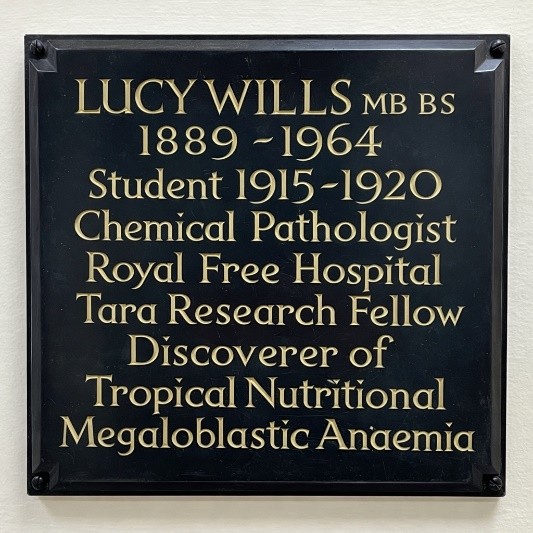
Figure 1. Plaque commemorating Lucy Wills on display at the UCL Royal Free Campus.
The London Royal Free Hospital School of Medicine for Women
Wills was a student at the London Royal Free Hospital School of Medicine for Women between 1915 and 1920 and later became a Lecturer (1931) and Senior Lecturer (1946) in Chemical Pathology at the school. This institution was a pioneer in training the first generation of women in Britain to become physicians [1]. The school, originally called the London School of Medicine for Women, was established in 1874 to provide women with formal medical education at a time when British medical schools excluded them [1]. The initiative was led by pioneering physicians such as Sophia Jex-Blake, Elizabeth Garrett Anderson, and Isabel Thorne, who faced strong resistance from the medical establishment when pursuing their own medical careers and were therefore determined to create opportunities for other women to study medicine (Figure 2).
Initially, the school focused on pre-clinical teaching because women were not permitted to undertake hospital-based clinical training. This barrier was overcome in 1877, when an agreement with the Royal Free Hospital (established in 1828 by William Marsden to provide free medical care for those who couldn’t afford it) allowed female students to complete their clinical studies there. This made the Royal Free Hospital the first London teaching hospital to admit women for medical training [1].
By 1896, the school was renamed the London Royal Free Hospital School of Medicine for Women and became part of the University of London. In 1947, it became co-educational and was renamed the Royal Free Hospital School of Medicine. It later merged with the University College Hospital Medical School in 1998 to form the Royal Free and University College Medical School, which was renamed UCL Medical School in 2008 [1].
Royal Free Legacy in training clinician scientists
Since its foundation, the Royal Free has not only made major contributions to training physicians to care for patients, but many of its graduates have also contributed to the further development of medical science through original research in science and medicine. Alongside Wills, Janet Lane-Claypon (1877-1967) is another outstanding early example. Lane-Claypon entered the school in 1898 and later made pioneering contributions to female endocrine physiology as well as epidemiology, having established the formal methodology of modern case-control studies with her 1926 report on risk factors for breast cancer [2].

Figure 2. Plaques commemorating the founder and some of students and lecturers at the London School of Medicine for Women (UCL, Royal Free Campus, Hampstead).
From Wills’ factor to folic acid
In 1928, Wills began her landmark research in India on macrocytic anaemia in pregnancy, a condition common among nutritionally deficient, low-income women especially those working in the textile industry in India. She joined the Maternal Mortality Inquiry at the Haffkine Institute in Mumbai. She observed that microscopically this type of anaemia was similar to pernicious anaemia that had already been described due to vitamin B12 deficiency in patients with gastric atrophy.
However, macrocytic anaemia in pregnancy was shown by Wills to differ from true pernicious anaemia, as patients did not respond to purified liver extracts (a source of vitamin B12) [3]. She reported in her paper, published in The Lancet in 1933 that “Clinical trials of various preparations containing vitamins B1, B2, and B4, failed to show that any of these vitamins have haemopoietic properties in tropical macrocytic anaemias. Marmite, an auto lysed yeast product, was active curatively in similar cases. The haemopoietic factor in marmite was soluble in water, and 80% alcohol, and heat-stable” [4].
The nature of this factor remained unknown until 1941 and was therefore referred to as Wills’ factor. Regardless of its chemical structure, this line of research led to a highly effective treatment for patients with megaloblastic anaemia in pregnancy, a condition that had caused considerable suffering, particularly among those from poor socioeconomic backgrounds. In 1941, researchers (most notably Herschel K. Mitchell, Esmond E. Snell, and Roger J. Williams from the University of Texas) isolated a growth factor from spinach leaves, which they named folic acid (from folium, meaning “leaf”).
Shortly thereafter, in the early 1940s, it was recognised that this newly isolated folic acid had the same biological activity as Wills’ factor [6]. This line of research led to the discovery of the mechanism by which folic acid and vitamin B12 are involved in the synthesis of DNA building blocks. Deficiency of these factors can therefore halt cell division, resulting in abnormally large cells (megaloblastic cells).
Folic acid and public health
In addition to the link between nutritional anaemia of pregnancy and folic acid deficiency, another connection between folic acid and neural tube defects (a congenital condition in which the structure that forms a baby’s brain and spinal cord does not close properly) was established over several decades. Early observations in the 1960s suggested a relationship between maternal nutrition and these congenital abnormalities, but strong evidence emerged and was later confirmed in 1991 by the Medical Research Council Vitamin Study, a randomised trial demonstrating that folic acid significantly reduces the risk of neural tube defects [7].
This led to widespread public health recommendations for supplementation before and during early pregnancy. This helped prevent significant suffering and improved quality of life, representing a major achievement for the scientific community. Based on such epidemiological evidence, many countries, including the UK, have fortified flour with folic acid as a public health measure to protect mothers and children from folic acid deficiency.
If you missed the first three artefacts on display by the UCL Historic Objects and Collections team, read their blogs, Bárány’s Box, the Kymograph and Haldane apparatus, to discover more about the history of physiology.
References
1.McIntyre, N. How British women became doctors: The story of the Royal Free Hospital and its medical school. 2014; Wenrowave Press.
2.Lane-Claypon JE. A Further Report on Cancer of the Breast, With Special Reference to Its Associated Antecedent Conditions. Reports on Public Health and Medical Subjects No. 32. Ministry of Health. London. 1926; Published by His Majesty’s Stationary Office.
3.Wills L. Treatment of “pernicious anaemia of pregnancy” and “tropical anaemia” with special reference to yeast extract as a curative agent. 1931. The British Medical Journal. 1931; 1059-1064
4.Wills L. The nature of the haematopoetic factor in marmite. The Lancet, 1933; 1283-1288.
5.Wills L, Clutterbuck PW, Evans BD. A new factor in the production and cure of certain macrocytic anaemias. The Lancet, 1937: 311-314.
6.Hoffbrand AV, Weir DG. The history of folic acid. Br J Haematol. 2001; 113(3): 579-89. doi: 10.1046/j.1365-2141.2001.02822.x.
7.MRC Vitamin Study Research Group. Prevention of neural tube defects: results of the Medical Research Council Vitamin Study. The Lancet. 1991; 338(8760): 131–137.