

Professor Derek Scott, 2026 recipient of the Otto Hutter Teaching Prize and Lecture, recommends new approaches for physiology teaching and education
“Physiology has long progressed through its capacity to adapt, scientifically, conceptually, and educationally,” states Professor Derek Scott (University of Aberdeen, UK). He adds, “In an era defined by rapid technological change, evolving societal needs, and increasing competition for disciplinary space, physiology faces pivotal questions about how it should evolve to remain relevant and impactful”.
Yesterday at our meeting, ‘Fit for the Future: Physiology Education and Teaching in the UK’, Derek encouraged all physiology educators to adopt a mindset of constructive disruption. Derek is the 2026 recipient of the Otto Hutter Teaching Prize and Lecture, the Society’s annual prize and lecture that recognises excellence and originality in physiology teaching. The prize celebrates the ground-breaking innovations and initiatives that mark a step change in education.
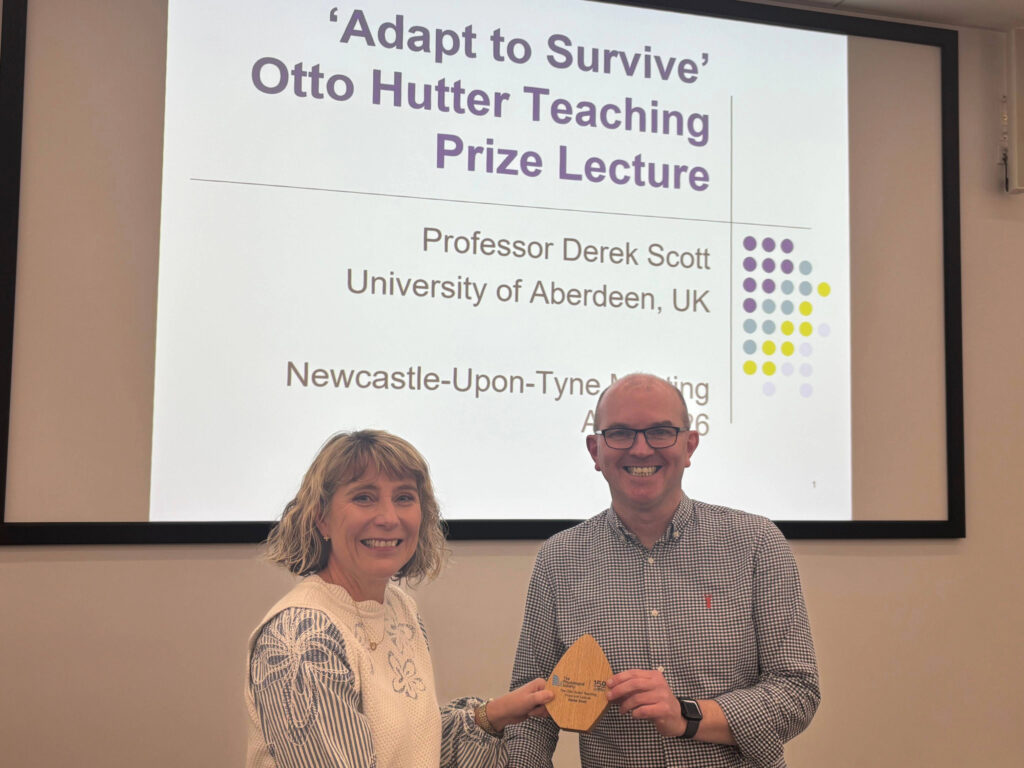
In his Prize Lecture, ‘Adapt to Survive’, Derek examined how purposeful adaptation could secure the future of the discipline, choosing to highlight the value of what he terms “disruptive physiology”. He describes it as “a willingness to challenge established norms and to experiment with new approaches in teaching, research, and application, rather than relying on traditions that have shaped physiology for decades”.
He explained that central to this adaptive process is the meaningful engagement of students as partners in curriculum design and pedagogical innovation. “Their insights and lived experiences can challenge assumptions, broaden our perspectives, and catalyse approaches that better reflect the ways today’s learners engage with scientific knowledge,” points out Derek.
Derek urged the physiology education community to strengthen its collective capability by fostering deeper collaboration across institutions, sectors, and career stages. “Greater integration of clinical and industrial colleagues into physiological training will enrich learning, enhance relevance, and better equip graduates to contribute to a rapidly evolving biomedical ecosystem,” he says. He emphasised the essential role of senior educators in mentoring early‑career colleagues, modelling scholarly generosity, and embracing open, collaborative practices that build capacity across our community.
“Securing the future of physiology demands more than reflection, it requires action,” states Derek. In recognising the societal and economic impact of physiology, along with its crucial role in addressing global challenges from healthcare to climate change, Derek explains that “physiology teaching should reflect both the current realities and future directions of our science”.
He called the education and teaching community to embed societal and policy-driven priorities into the curricula. Inviting them to work in partnership with students, clinicians, and industry; and to collaborate more deliberately as a unified community. Derek concludes that “through these commitments, physiology can adapt with confidence. Remaining vibrant, resilient, and inspirational for the generations who will carry the discipline forward”.