

Professor Kristen Harris has been awarded the 2026 Hodgkin Huxley Katz International Prize Lecture for her 3D models and pioneering techniques to discover how new memories are created in the brain.
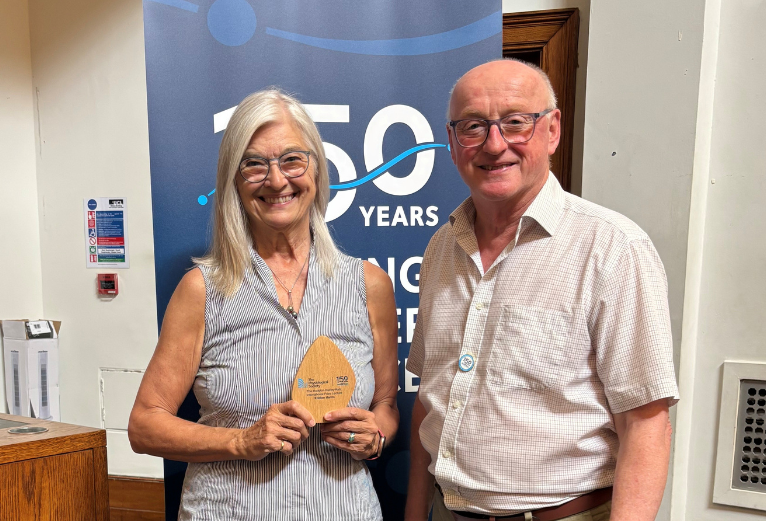
How are new memories formed? For the last 20 years, Professor Kristen Harris (University of Texas at Austin, US), has pursued the structural basis of learning and memory. Today, she captivated us with her laboratory tales of exploring the mechanisms and structural changes of synapses, the communication junctions responsible for transmitting signals, which form trillions of connections in the brain.
As the 2026 recipient of the Hodgkin Huxley Katz International Prize Lecture, Kristen presented ‘Structural synaptic plasticity during long-term potentiation (LTP)’ at our ‘Celebrating Physiology in London’ event at University College London, UK. She discussed the new techniques her lab has pioneered, including computer-assisted approaches to analyse individual synapses in three dimensions through serial section electron microscopy under a variety of experimental and natural conditions.
“We studied the cellular mechanism, long-term potentiation (LTP), which modifies the strength and structure of synapses, and is vital for learning,” says Kristen. She explained that three-dimensional electron microscopy has revealed distinct pre- to post-synaptic arrangements. These are broken down into, “Strong active zones that have tightly docked presynaptic vesicles, weak active zones that have loose or non-docked vesicles, and nascent zones which have a postsynaptic density but no presynaptic vesicles.
Kristen explained that LTP can be temporarily saturated, which prevents further increases in synaptic strength. “We have used 3D reconstruction from serial section electron microscopy to discover how the plasticity of nascent zones provides a time dependent and synapse-specific expansion of active zones during LTP,” states Kristen. She adds, “this expansion ultimately encourages the formation of highly effective dendritic spine clusters regulated by the spine apparatus”.
Kristen introduced their rat model system with knockout of synaptopodin. They used it to investigate the cluster hypothesis, in which they predict that the saturation of LTP protects recently formed memories, and that regrowth of nascent zones accounts for the advantage of spaced over massed learning.
Kristen’s novel insights build on decades of research into neural mechanisms and function, which includes the landmark findings on action potentials by Nobel Prize winners Sir Alan Lloyd Hodgkin (1914 –1998) and Sir Andrew Fielding Huxley, and Sir Bernard Katz’s (1911 –2003) discovery of variations in neurotransmitter release at synapses. Fitting for the annual prize lecture that celebrates the international impact of the work of Hodgkin, Huxley and Katz.