
News & Views
Encouraging early engagement in career planning
By Dr Dawn Davies and Sarah Phillips, University of Bristol, UK
I am a teaching-focused member of staff at University of Bristol, with an interest in widening participation and supporting the development of transferrable skills, especially related to how students develop critical analysis and problem solving skills.

Dr Dawn Davies

Sarah Phillips
We are all familiar with supporting our students to develop their research skills, gaining a greater comprehension of the scientific process and how it has helped us to arrive at our current understanding of a particular scientific area. But how much opportunity do we give students to build their careers research skills, explore and reflect on their values and interests and develop as proactive careers and employability thinkers?
The internship conundrum
In recent years, we have observed students putting off career research until later in their degrees. However, alumni often share the importance of engaging in careers provision early in students’ degrees. Some reluctance to start career planning may arise due to the greater value placed on spending time on academic or paid work as well as more complex societal and individual factors at play. However, at some point, probably in the second of a three-year degree, most tutors or careers staff have probably come across the increasingly desperate question ‘how do I get an internship?’, coinciding with students starting to think about their future careers.
Internships are often seen as the golden ticket to future employment. Whilst there is no doubt that internships can offer students the opportunity to gain experience of a sector, develop skills and networking opportunities that may increase their chances of securing a postgraduate job, there can be substantial barriers to securing internships (Holt-White and Cullinane, 2025). The number of internship opportunities has recently reduced; university interns and placement hiring fell by 5% between 2023 and 2024 according to the Institute of Student Employers (2024). Moreover, traditional internship or placements can exacerbate inequalities as students from private schools are more likely to take on employment for experience whereas state school students are more likely to work to support living costs (Grey, 2024; HEPI, 2022). Additionally, whilst many students engage in a diverse range of enriching extra-curricular and curricular activities, we’re aware of the need to help students recognise the value of these experiences. Many are work-related experiences and valid both for their career exploration and for their future careers.
Thus, it is important that we support students to look at employability through a different lens. Starting with themselves – our goal being to support students to reflect on their skill development, recognise the value of these skills in specific careers and seek alternative ways to develop skills via work-related experiences or learning.
Assessments to support employability
With these factors in mind, in collaboration with the Careers Service, we developed summative assessments to help them focus on improving their career literacy skills.
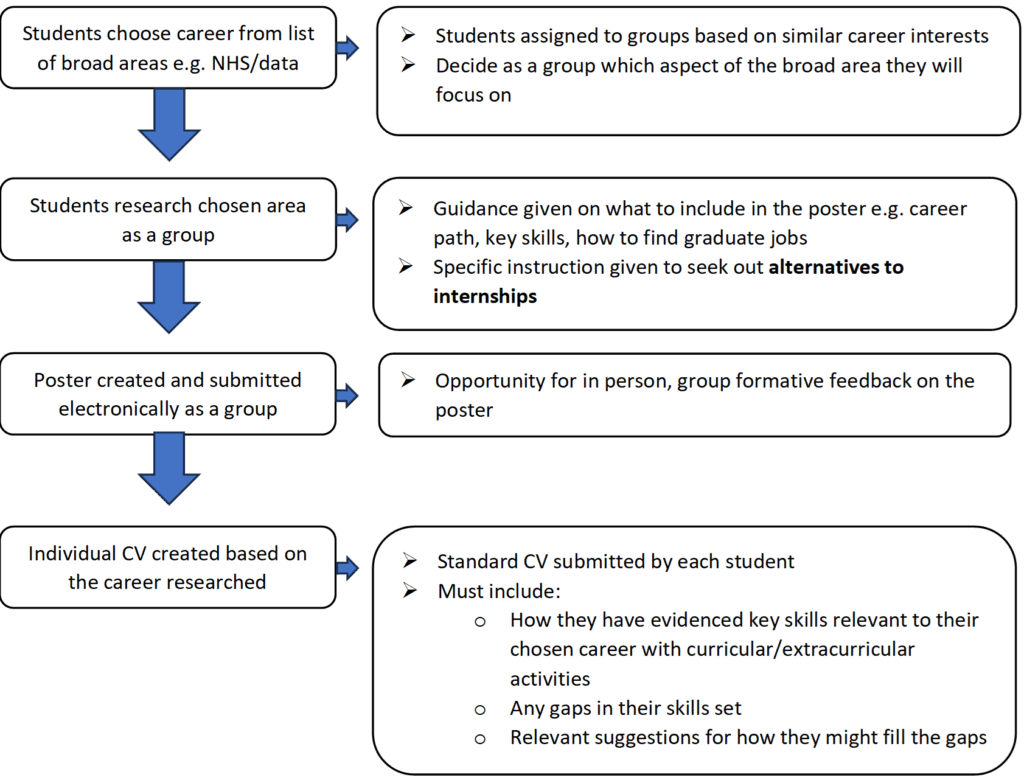
Students in the first term of year 2 on the Physiology, Pharmacology, Neuroscience or Biomedical Sciences degree worked in groups to research a career and produce a poster based on their research aimed at informing their peers and engaging them in finding out more about a specific career. The student workflow for this assessment is shown in Fig. 1.
Alongside describing the career path, students were directed to research the skills required for the job and ways to demonstrate capabilities both from within their curriculum and with extracurricular activities. In terms of work experience, students were specifically encouraged to think beyond internships and identify alternative work-related or skill development opportunities. In parallel to this assessment, students produced a CV that was tailored to their chosen career.
Students were directed to construct a standard CV but a major part of this assessment focussed on student reflection on their current skill set, how this fitted with the requirements of the career they had researched, identifying gaps and suggesting ways that these could be filled either through curricular and/or extracurricular activities.
Whilst the majority of posters produced (71%) included reference to internships or placements, indicating the importance that students still place on these opportunities, 84% posters also included credible alternatives including specific volunteering opportunities, non-academic writing and online courses to extend expertise. An example of this was disseminating code onto open platforms to demonstrate skills for Data Science careers. This was also reflected in their responses within the CV assessment.
These assessments provide students with an opportunity to engage with career planning within their curriculum, with a focus on reflecting on their current skill set and how to develop skills further to increase employability. Going forward, we plan to gather more data on whether/how students follow up on their research into the specific career and if not, why not. It was clear that as the students were working in groups, some were not researching careers they were primarily interested in but we believe that the skills that they gained through engaging with the research and reflecting on their own skills will be invaluable in progressing their career planning throughout their degree and, thereby, increasing their career literacy.
References
Grey M. (2024). Some observations from working across the sector in 2024. LinkedIn Mike Grey FRSA on LinkedIn: Some observations from working across the sector in 2024: 📈The push for…
HEPI. (2022). Student Academic Experience Survey 2022 Student Academic Experience Survey – HEPI
Holt-White E & Cullinane C. (2025) Sutton Trust Research Brief https://www.suttontrust.com/wp-content/uploads/2025/01/Unpaid-and-Underpaid-Internships.pdf.
Institute of Student Employers (2024). Student Recruitment Survey 2024 ISE Recruitment Survey 2024 – Institute of Student Employers
Acknowledgements
We would like to thank Professor Sheila Amici-Dargan and Dr Lucy Alford in the School of Biological Sciences at the University of Bristol for the original idea for the careers poster as a curricular, assessed project and generous sharing of resources.