Membership
Films as a useful and engaging teaching tool
By Áine Kelly (Professor in Physiology, Trinity College Dublin, Ireland) and Christopher Torrens, Associate Professor in Physiology and Physiology Education, Royal College of Surgeons, Ireland
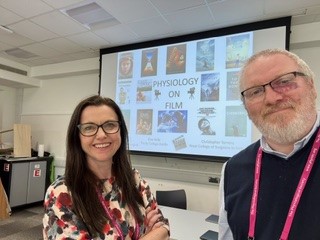
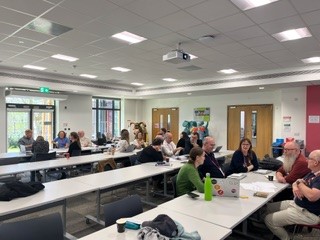
The Physiological Society meeting ‘Challenges and Solutions for Physiology Education’ held at University of Bristol hosted ‘Physiology on Film: An Interactive Workshop’, facilitated by two members based in the Republic of Ireland. Here, they explain the background to the workshop and why they think that films are a useful and engaging teaching tool that bring physiology to life for students.
Áine Kelly is Professor in Physiology at Trinity College Dublin where she completed a degree in Physiology and PhD in Neuroscience. She’s been an academic in Trinity since 2002, following postdoctoral work in Trinity and in Université Paris Saclay. She teaches physiology across multiple science and health sciences courses, from first year to final year.

Áine Kelly
Christopher Torrens is Associate Professor in Physiology and Physiology Education at the Royal College of Surgeons in Ireland. He completed a degree in Biological Sciences at Glasgow Caledonian University and then a PhD in vascular physiology at the University of Southampton. He did some postdoctoral work at Southampton and the University of Auckland, before being appointed as a lecturer in Physiology at Southampton in 2006. He taught physiology at Southampton for over a decade, before returning to Ireland to take up his current post at RCSI in 2020.
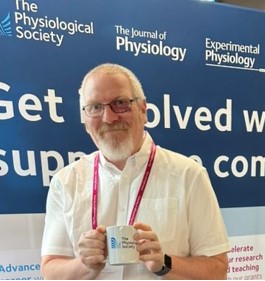
Christopher Torrens
What inspired the idea for looking at physiology and film and how is it incorporated into teaching and learning?
For Áine, the inspiration came from a conversation she had about six or seven years ago with the Society’s President-Elect Professor Mike Tipton about his experience as a consultant on the 2015 film ‘Everest’. It got her thinking about the accuracy of representations of physiology in other films and from that point she started scattering film references into some of her lectures.
Then about five years ago she redesigned a module she teaches on Integrative Physiology to final year physiology degree students, where part of the assessment is based on student presentations of different topics in physiology. She realised that including a session where the students present a critique of the portrayal of physiological scenarios in films could be both fun and instructive.
Christopher had the opportunity to create a week-long student choice course and wanted to do something about physiology that went above and beyond the normal teaching experience. He centred it on extreme physiology. The assessment required some scenarios the students could assess, and rather than look for published case studies, he thought of countless disaster and space movies that the students could critique. He then decided to add reference to films in his main teaching to provide both good and bad examples but also to give a tangible example of extreme situations.
Their shared interests and the positive feedback from students led to a desire to share their experiences with fellow physiology educators and the development of a workshop at the Bristol meeting.
How do students find the approach and the experience?
The feedback has been very positive overall in both cases. Students like the fact that they get to research topics in depth but in a completely novel and engaging way. They say that it provides a break from more traditional types of assessment and some even comment that it helps them explain to their family and friends what physiology is, especially when they watch the films together. Students have really enjoyed thinking through the homeostatic challenges that protagonists face in the various situations they choose and engage enthusiastically in both the research and the subsequent class discussions.
What educational benefits have been seen through using film to look at different physiological reactions?
This approach requires students to integrate different concepts across multiple physiological systems; for example in portrayals of survival or extreme physiology, they need to think about how a given scenario will affect aspects of physiology that are visible to an observer, such as respiratory rate, whether or not someone would be sweating or fatigued or flushed or shivering, whether they would be confused or feeling pain etc. There is also the advantage of error spotting as depictions in films may be exaggerated or wholly unrealistic. As such the students may critique the depiction, point out the problems and give a more realistic description. Within genres such as science fiction or super-hero films there is also the option to hypothesise how such alien or super physiology might exist.
What advice would they give educators looking to use films in their teaching?
Just go for it! It can be as simple as making a reference to a scene in a well-known film such as Titanic when you are teaching thermoregulation, through to our approaches which mean students have to fully critique either specific scenes or even full movies. Once you start looking you will see potential examples everywhere.
Have any suggested films resonated with the students or sparked particularly interesting or unexpected discussions?
It’s always interesting to discuss the physiology, but some of the most thought-provoking discussions have centred around ethics, especially in films set decades ago. For example, the past treatment of people committed to institutions, as portrayed in One Flew Over the Cuckoo’s Nest, attitudes to people with HIV/AIDS, as depicted in Dallas Buyers Club, or the ethics surrounding prescription of opioid painkillers that lead to addiction. Within space physiology, several of these movies have prompted discussion around mental health and the impact of isolation. The best thing about the discussions and presentations is the quality of the students’ work. They get really interested in the topics and put a huge amount of work into the presentations. These classes are among our favourite ones to teach every academic year.