

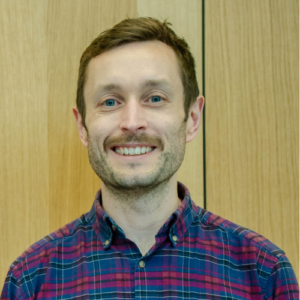
Dr Liam Bagley
Deputy Head of Department of Life Sciences, Manchester Metropolitan University, UK
“Did you think you would be doing this when you worked at the bank?” Dr Liam Bagley reflects on his own ‘squiggly career’ path into physiology education.
The term ‘squiggly career’ was brought up by colleagues in career services at a recent meeting, highlighting that career journeys are rarely perfectly linear. Some will take more of a “scenic route” to their destination, which can add so much to someone’s overall personal development. A few weeks later, I attended the Physiological Society’s 2026 edition of the Education and Teaching Annual Meeting, hosted by colleagues at Newcastle University. Having grown up in the Northeast of England, I took the opportunity to stay with my dad. The night before, he asked me, “did you think you would be doing this when you worked at the bank or with the army?”
Talk about a ‘squiggly career’… … …
From bank clerk to biomed student
Biology was one of my favourite subjects at school, especially human biology. I didn’t have the most successful time at school and college, so wanted to begin my working life as soon as possible. I found work as a bank clerk, a job which taught me a lot of skills and gave me some useful professional experiences. After a few years there, one day at my desk, I felt ready again to study and my love for biology was rekindled.
I moved from the Northeast of England and began a degree in Biomedical Science as a (not so) mature student, going on to postgraduate study and even a brief stint in a military career to add to my somewhat ‘quirky’ (as my wife describes it) or “squiggly” (as my careers colleague puts it) professional background. I count on many mentors throughout that time in both research and education, including my then PhD supervisor and long-standing Society member, Professor Jamie McPhee, who within the first week of study added to my to-do list: “Look at Physiological Society membership”.
Becoming a physiology educator
When I graduated from PhD, I was employed as a tutor at Manchester Metropolitan University. That role was really the beginning of my education journey in finding “my thing”. It started a fascination of how to bring the science of life, to life. I was inspired and in awe of colleagues who treated the lecture theatre as quite literally the theatre.
I became hooked with the history of physiology education. I read of amazing characters and personalities in this field we work in, and did my utmost in my teaching sessions to get excited about the best thing since sliced bread…… physiology. Roles that followed were mentored by experienced and knowledgeable colleagues, including Dr Gethin Evans, Dr Nicola Hughes, Dr Lisa Coulthwaite and Professor Carol Ainley. All of whom I owe a debt of gratitude for their support and guidance but also in allowing me creative freedom, something often overlooked as a key ingredient in exciting and interesting teaching. I’ve therefore almost always been on a focussed education track in my career, but only recently have I truly and proudly embraced this identity.
Standing at a career crossroads
The seed was planted when I attended the Physiology 2019 conference in Aberdeen (UK). I recall being sat in an education symposium, when a speaker said words to the effect of “it is very nice to see so many colleagues and friends sat here in an education symposia, not so long ago, you would have all been wearing a disguise to walk into an education symposium at a scientific conference, not anymore”. Up until that point, my mind had been very research focused. It was heartening to know there is a community of likeminded people out there who were enjoying and thriving in the teaching part of their jobs every bit as much as I was. I walked away from the conference inspired by the Society members who were unanimous in spreading the message of “you can do this”.
Finding the education and teaching community
At the time, my institution introduced new academic career pathways, allowing staff to follow research or education routes. I found myself at a crossroads, torn between my identity as a researcher and my growing passion for teaching, where I was just beginning to see real impact.
Then, one morning, an email invitation caught my eye: a call for abstracts for a conference at the University of Leeds (UK) focused on innovation in teaching across physiology and STEM. Having recently completed work on a project surrounding skills training and assessment, I decided to take the plunge into education research, safe in the knowledge that this was part of the supportive environment that is the good ship of the Physiological Society.
That conference proved transformative. It not only confirmed that education research was “my thing,” but also connected me with inspiring colleagues and sparked collaborations I hadn’t thought possible. Looking back, I can trace almost all my subsequent education projects, directly or indirectly, to that experience. I even made my first appearance in Physiology News, fame at last.
Collaboration and friendship
The Society’s Education and Teaching community is the definition of ‘community’. In a very short space of time, I have met some wonderful colleagues and collaborators. I am struck by the collegiality and friendship this field of physiology develops.
It is comforting to know that I could write to the education and teaching community today and have support and collaboration from colleagues and friends tomorrow. This is a community that truly does care about the progression and development of its members, as well as being the most welcoming and inclusive I have known.
Mentors and support
It took approximately six years to complete my metamorphosis to physiology educator. The teaching and education meetings from the Physiological Society really have been a game changer for me from a career perspective. I have met and worked with colleagues at other institutions on education projects and joint outputs, something I did not feel was possible before.
The career support sessions at these meetings have been nothing short of inspirational and when those colleagues say that they are very happy to support and mentor others at these events, they genuinely do mean it.
These events are not only an annual meeting of physiology and bioscience educators, but they have also become a meeting of colleagues and friends, something I feel that few meetings can match!
Storytelling and immersive learning environments
My education research and practice focus is primarily on skills and experience training. My education work focusses on how we can train students with professional skills and simulate their application to prepare them for the modern job market. I am also interested in innovations in how we facilitate and assess these through digital and immersive experiences. I am a huge advocate of ‘learning by doing’ and the power of simulation, storytelling and immersive learning environments.
What advice would you give to someone who is considering an education-focused career?
There is a prosperous and exciting career here for you. The education and teaching community meetings have fundamentally changed my career outlook and have shaped my future career plans. Mentorship has been essential in my career thus far, of which I am fortunate to count many at my own institution and beyond. I recommend you seek out mentors and be bold. Ask to get involved and send emails. Do this and you can be part of a supportive community of physiologists who will be there to work with and support you.