Events
Meet the early career researcher competition winners and runners-up
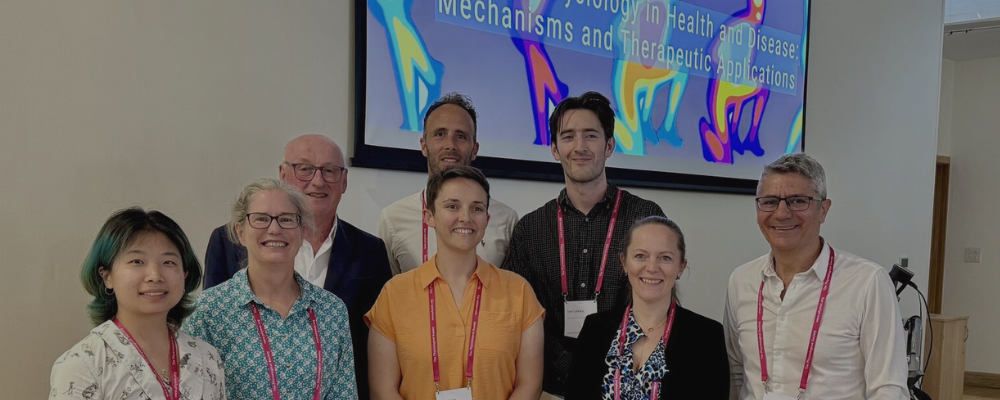
Sam Leaney, Aislin Fields and Chenyu Fan were the oral and poster competition winners at our ‘Thermal Physiology in Health and Disease: Mechanisms and Therapeutic Applications‘ meeting at Brunel University of London, UK. Following the award presentation, we interviewed them to find out more about their research, what drives their curiosity about their topic, the findings and their future hopes for their projects.
Sam Leaney, Bangor University, UK
Michael J Rennie Oral Communication Prize winner for their presentation, ‘Acute hot water immersion does not reduce 24-hour blood pressure in young healthy adults’.
My interest in thermal physiology developed during my time as a sport scientist at the Human Performance Unit at University of Essex, where I provided physiological support to athletes preparing for competitions in extreme climatic conditions. The opportunity to further pursue this interest came when I was successful in obtaining a PhD studentship at The Institute for Applied Human Physiology, Bangor University to study the potential benefits of environmental stress on cardiovascular and cerebrovascular function. One focus of the PhD thesis has been to examine the influence of passive heat stress (hot water immersion) on blood pressure.
Following longer-term passive heat therapy (sauna or hot water immersion), reductions in resting arterial blood pressure are frequently reported across a range of clinical and non-clinical populations. We believe that the magnitude and time course of post-heat stress hypotension may provide insight into the hypotensive benefits of heat therapy, and therefore we examined the post-hot water immersion hypotension with 24-hour ambulatory blood pressure monitoring.
I presented the preliminary data from this experiment (n = 13) at the Physiological Society’s meeting on ‘Thermal Physiology in Health and Disease: Mechanisms and Therapeutic Applications’.
As hypothesised, blood pressure was reduced (- 5 mmHg) compared to a resting control condition when recorded at 60 minutes after hot water immersion. The magnitude of the hypotension was comparable to that typically observed after exercise, which is partly attributed to the health benefits of regular exercise.
Despite this acute reduction in blood pressure, we did not observe reductions in the 24-hour ambulatory blood pressure monitoring (daytime, nighttime or overall 24-hour blood pressure). Although not statistically significant (P = 0.06), we found a medium to large effect (d = 0.62), indicating the nocturnal dip percentage in diastolic blood pressure was numerically larger after hot water immersion than in the control condition.
It will be interesting to determine if this difference in nocturnal blood pressure persists once we complete the full data collection, as it may provide insights into why regular passive heating is associated with cardiovascular health benefits.
What next? I hope to see our research contribute to the mechanisms of heat stress and help identify passive heat therapy protocols for improving cardiovascular health in a safe and inclusive fashion.

Sam Leaney (Bangor University, UK) Michael J Rennie Oral Communication Prize winner
Aislin Fields, University of Southampton, UK
Early Career Researcher Poster Competition winner for their poster, ‘Individual variability in clothing thermal behaviour: a multidisciplinary review of physiological and ethnographic literature’.
Post-lecture conversations about cycling with my undergraduate physiology lecturer Dr Sean Roe led me to pursue a MSc in Sport and Exercise Physiology. I then had the chance to work with the incredible scientists behind the British Sailing Team, aiding in heat acclimatisation protocols ahead of the 2024 summer Olympics.
Outside of work, every weekend you can find me at parkrun, and there I have seen the incredible mental, physical and social benefits of gaining access to exercise for all who partake. My current research has shifted my focus from honing elite performance to facilitating wider exercise participation. Through this I have found a whole new sense of purpose.
Our work explores thermal behaviour as a key component of how humans regulate body temperature (alongside autonomic physiology), particularly the effect of individual characteristics on thermal behaviour. In our review, we identified relatively little research in this area, and even fewer instances where a certain characteristic was explored in both physiological and ethnographic literature.
However, where possible, triangulation of the different studies provided additional insight and nuance into how physiological, psycho-social and cultural implications of a characteristic may influence behaviour. Here I see exciting evidence for the value of a holistic approach to understanding the decision-making processes underlying behavioural thermoregulation, informed by the interaction of both thermal inputs and wider cultural context. Only by combining these crucial determinants can we hope to understand people’s behaviour in their daily lives and then strive to understand the risks different populations are facing in an increasingly hostile climate.
Personally, I am thoroughly enjoying the challenge of learning about qualitative research and finding effective ways to combine the fields of ethnography and physiology. I hope that my future research may identify characteristics which could cause greater vulnerability to heat stress and associated decreased exercise access, which could then be addressed.
For example, as my PhD is co-funded by athletic apparel retailer Lululemon, insights from my work may be used to inform more inclusive design of sportswear to address some of the differences in preferences or behaviours from different groups. If my work could in some way facilitate individuals having better access to safe, enjoyable physical activity that would be the most fulfilling outcome I could conceive of.

Aislin Fields (University of Southampton, UK) Early Career Researcher Poster Competition winner
Chenyu Fan, University of Southampton, UK
Runner up of the Early Career Researcher Poster Competition for their poster, An inter-disciplinary review of the applications and models of skin wetness perception research and associated experimental methods.
My journey into thermal physiology began with my background in textile science. Initially, I focused on how fabrics could enhance human comfort, specifically, the driving force behind centuries of innovation in clothing design. However, during my previous research on skin thermal and moisture comfort, I realised that I’m more interested in the thermoregulation mechanisms, such as the skin response in thermoregulation, and its sensory perception.
This question inspired my poster presentation at the Thermal Physiology meeting, “An interdisciplinary review of the applications and models of skin wetness perception research and associated experimental methods.” Skin is our primary interface with the environment. I wanted to systematically review the latest studies to map out how different disciplines approach wetness perception and to identify new directions for advancing both physiological understanding and application innovation.
Most studies on wetness perception focus on interactions between skin and textiles, but the findings often remain confined within their own domains. Although there is an overlap in the factors influencing wetness sensation, such as contact area, temperature, and evaporation, there is still no unified model that integrates these parameters across different applications.
What I found most fascinating was how findings from different disciplines, from neuroscience to clothing engineering, can complement one another by filling gaps and highlighting different aspects of the same sensory phenomenon. Through this review, I also noticed that wetness perception plays an important role in medical applications, such as wearable sensors and prosthetics. However, the mechanisms of how the skin senses humidity in the air, or known as micro-environment, have not been clearly discussed. This gap inspired the experimental research I’m now conducting on skin humidity perception in the air.
My next step is to experimentally investigate how humans perceive humidity in the air. I’m currently conducting a study examining how ambient temperature and relative humidity affect this perception, and whether males and females differ in their responses. Forty healthy participants attend controlled climate chamber sessions at 18°C, 27°C, and 36°C, where humidity gradually increases from 40% to 95%. Testing and report of this study should be completed before next summer.
The findings should help uncover the sensory mechanisms behind air humidity perception and provide insights into sex-related differences. This research could guide the design of more comfortable indoor environments and support adaptive strategies for different physiological needs.