
By Alireza Mani (University College London) and Tara Dehpour (Hull York Medical School)
In the UCL Historic Objects and Collections series, the team explores the stories behind the objects housed within the institute’s rich collection. The object featured in this blog is a popular science book on human physiology. It was written in 1949 by Winifred Cullis (1875–1956), the first woman to hold a Professorial Chair in Physiology in the United Kingdom.
Beyond the Laboratory
“The owner of a new bicycle or sewing machine who understands the way in which these things work has more chance of getting the best out of them than one who knows nothing of the way they work and does not care to find out. You now know something of the way in which your body works and so you have a good chance of making use of it, if you will apply this knowledge.”
These are the closing words of ‘Your Body and the Way it Works’, a 32-page book on human physiology for the general public (Figure 1), published in 1949 and written by Winifred Cullis, who held the Chair of Physiology at the London School of Medicine for Women. The book explains the principles of human physiology in clear, accessible language and is richly illustrated, often using analogies with familiar mechanical systems to explain the circulation, breathing, and other physiological systems (1).
A particularly interesting aspect of the book is that it does not simply present physiological facts; it also explains how scientific knowledge is acquired. For example, Cullis demonstrates how exhaled air turns limewater milky to illustrate how physiologists discovered that exhaled air contains a much higher concentration of carbon dioxide than inhaled air (Figure 2). By introducing readers to the experimental evidence behind physiological concepts, she encouraged an understanding of both the scientific method and the physiology itself. The book also includes a three-page section entitled “Things to Do”, which contains simple experiments that can be performed at home to help readers understand physiological concepts and make them more tangible.
Winifred Cullis was an accomplished physiologist whose laboratory research made contributions to several areas of physiology (2-12). Beyond the laboratory, however, she recognised the importance of making physiological knowledge accessible to the wider public. As reflected in the final illustration of the book, she believed that an understanding of the human body was fundamental to building “healthy families”. Her contribution as a science communicator was widely recognised. A review published in Nature in 1949 noted that “Prof. Winifred Cullis has gained an enviable reputation as a popular interpreter of human physiology” (13).
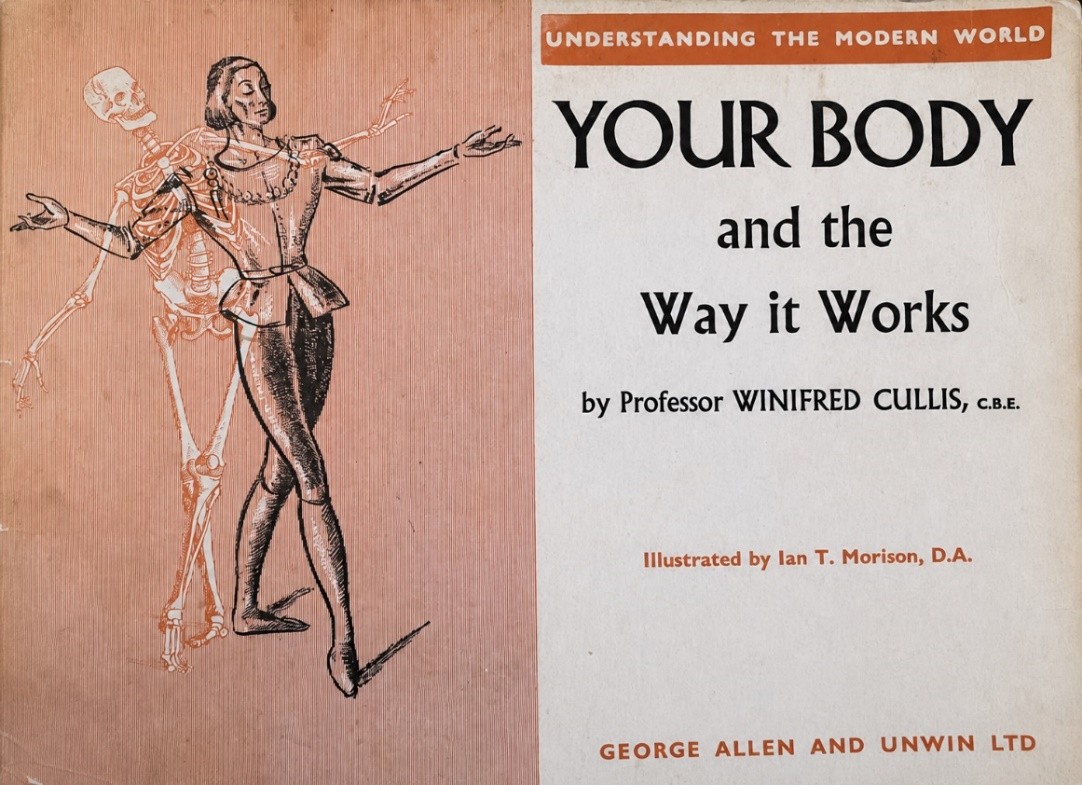
Figure 1. Cover of the fifth edition of Your Body and the Way it Works by Winifred Cullis, published in 1961.
From Cambridge to the London School of Medicine for Women
Cullis studied Natural Sciences at the University of Cambridge and began her research in the Cambridge Physiological Laboratory under John N. Langley. In 1901, she assisted Thomas G. Brodie in the research laboratories of the Royal College of Surgeons and the Royal College of Physicians in London. Later that year, she was appointed Demonstrator in Physiology at the London School of Medicine for Women. Founded in 1874, the school was the first medical school in Britain to provide women with formal medical education at a time when they were excluded from other British medical schools (14). Cullis joined this pioneering institution to teach physiology and was subsequently promoted to Lecturer (1903), Reader (1912), and later Head of the Department of Physiology.
In 1919, she became Professor of Physiology, making her the first woman to hold a professorial chair at a medical school in Britain. In 1926, she was appointed to the Sophia Jex-Blake Chair of Physiology, named in honour of one of the school’s founders. The London School of Medicine for Women, later known as the Royal Free Hospital School of Medicine, merged with UCL in 1998. Throughout its history, the school trained many distinguished scientists and physicians who made important contributions to our understanding of human health and disease (see our recent blog on Lucy Wills).

Figure 2. Illustration of a simple experiment demonstrating that exhaled breath contains carbon dioxide by turning limewater milky.
Winifred Cullis’s scientific contributions
A review of Cullis’s scientific publications, many of which appeared in The Journal of Physiology, reveals the breadth of her research interests. Her early work with Brodie focused on urine formation and osmotic diuresis using the frog as an experimental model (2,3). This was followed by the development of an apparatus for perfusing the isolated mammalian heart, which enabled the temperature of the preparation to be maintained at a constant level (5). This innovation reduced an important source of experimental error, as changes in temperature can alter heart rate and the force of cardiac contraction, potentially confounding the interpretation of experimental results (5).
Her subsequent studies using the isolated heart led to important discoveries in cardiac physiology, including evidence that the ventricles do not receive vagal nerve fibres (8) and that incomplete interruption of the bundle of His causes partial heart block (7). These findings contributed to the understanding of cardiac innervation and the role of the atrioventricular node and the His bundle in cardiac conduction.
During the First World War, Cullis joined the Endell Street Military Hospital in Covent Garden (London), where she carried out research relevant to the treatment of wounded soldiers alongside other female physiologists, including Enid Tribe (15). Staffed by medical personnel from the Royal Free Hospital and founded by suffragists, the hospital adopted the motto “Deeds, Not Words” (15). Cullis investigated cardiac output and lung function in soldiers with chest injuries. Drawing on this experience, she later improved the method for measuring cardiac output and, after the war, published the technique with Olive Rendel and Ellen Dahl (10,11).
Core body temperature fluctuations in women
Cullis’s work ranged from fundamental physiology to clinically relevant research during the First World War. She also made important contributions through observational studies in healthy volunteers. One of her most notable investigations examined changes in core body temperature during the menstrual cycle (Figure 3). Working at the London School of Medicine for Women, she studied 16 female medical students who recorded their daily body temperature, pulse rate, and blood pressure over periods of 3-11 months, allowing multiple menstrual cycles to be analysed for each participant. The study demonstrated consistent cyclical changes, particularly in body temperature, which peaked during the pre-menstrual phase and reached its lowest point during menstruation (Figure 3). Published in the Lancet, the work was recognised as an important contribution to understanding normal female thermoregulation (9). The study was published in 1922, although the observations had been carried out six years earlier, in 1916. Cullis explained that publication had been delayed because analysing the large volume of data required considerable time. As she wrote, “the detailed consideration of such a large number of figures requires more time than has been at the disposal of the instigator of these observations. (9)” This remark highlights both the painstaking nature of physiological research at the time and the extensive manual analysis required before the era of computers.
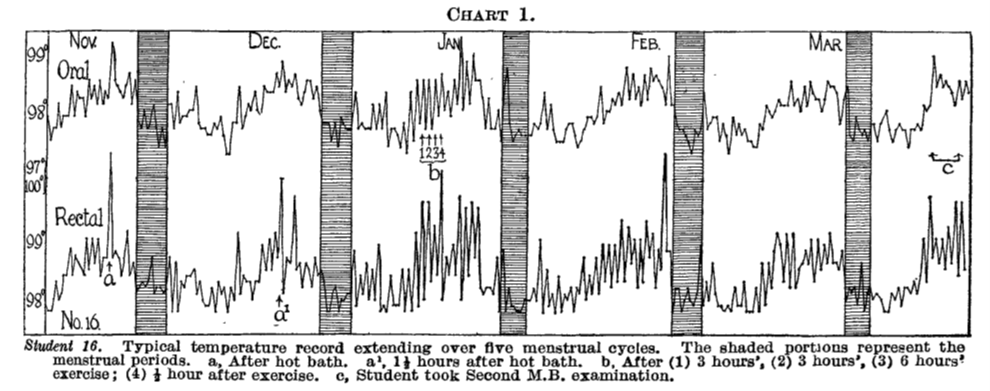
Figure 3. Typical oral and rectal body temperature record extending over five menstrual cycles from the 1922 paper by Winifred Cullis, Enid Tribe (later Enid Oppenheimer), and Margaret Ross-Johnson.
Joining the Physiological Society
Cullis was a pioneer in physiology in many respects. In 1915, she was among the first women to become members of the Physiological Society, alongside Florence Buchanan, Ruth Skelton, Sarah Sowton, Constance Leetham Terry, and Enid Tribe (16). She continued to break new ground by becoming the first woman to serve on the Society’s Committee, holding the position from 1918 to 1925. In 1920, she achieved another milestone as the first woman to preside over a meeting of the Physiological Society (16).
Public engagement
Winifred Cullis believed that physiology should extend beyond the laboratory into everyday life. Through her teaching, public lectures, and popular books, including The Body and its Health (1935) and Your Body and the Way it Works (1949), she made the science of the human body accessible to the public and inspired generations to appreciate the value of physiology for healthy living.
If you missed the first six blogs by the UCL Historic Objects and Collections team, read Bárány’s Box, the Kymograph, Haldane apparatus, From Wills’ factor to folic acid, From squid giant axons to recording action potentials inside a nerve fibre and Measuring the invisible: The Hartridge Reversion Spectroscope to discover more about the history of physiology.
References
- Cullis W. Your Body and the Way it Works. George Allen & Unwin, London, 1949. Illustrated by Horace J. Knowles. 32 pages.
- Brodie TG, Cullis WC. On the secretion of urine. J Physiol. 1906; 34(3):224-49. doi: 10.1113/jphysiol.1906.sp001153.
- Cullis WC. On secretion in the frog’s kidney. J Physiol. 1906; 34(3):250-66. doi: 10.1113/jphysiol.1906.sp001154.
- Brodie TG, Cullis WC. The analysis of oxygen and carbonic acid contained in small volumes of saline solutions. J Physiol. 1908; 36(6):405-13. doi: 10.1113/jphysiol.1908.sp001239.
- Brodie TG, Cullis WC. An apparatus for the perfusion of the isolated mammalian heart. J Physiol. 1908; 37(4):337-40. doi: 10.1113/jphysiol.1908.sp001275.
- Brodie TG, Cullis WC, Halliburton WD. The gaseous metabolism of the small intestine: Part II. The gaseous exchanges during the absorption of Witte’s peptone. J Physiol. 1910; 40(3):173-89. doi: 10.1113/jphysiol.1910.sp001365.
- Cullis WC, Dixon WE. Excitation and section of the auriculo-ventricular bundle. J Physiol. 1911;42(2):156-78. doi: 10.1113/jphysiol.1911.sp001430.
- Cullis W, Tribe EM. Distribution of nerves in the heart. J Physiol. 1913; 46(2):141-50. doi: 10.1113/jphysiol.1913.sp001582.
- Cullis WC, Oppenheimer EM, Ross-Johnson M. Observations on temperature and other changes in women during the menstrual cycle. Lancet. 1922; 200(5175): 954-956.
- Cullis WC, Rendel O, Dahl E. The application of the ethyl iodide method to the determination of the circulation rate in women. J Physiol. 1926;62(1):104-14. doi: 10.1113/jphysiol.1926.sp002342.
- Cullis WC, Rendel O, Dahl E. Observations on the ethyl iodide method for the determination of heart output. J Physiol. 1927; 64(1):39-46. doi: 10.1113/jphysiol.1927.sp002417. PMID: 16993900; PMCID: PMC1514971.
- Cullis WC, Scarborough EM. The influence of temperature in the frog: (1) On the circulation, and (2) On the circulatory effects of adrenaline and of sodium nitrite. J Physiol. 1932; 75(1):33-43. doi: 10.1113/jphysiol.1932.sp002872.
- T.H.H. Your body and the way it works. Nature, 1949; 162: 664.
- McIntyre N. How British women became doctors: The story of the Royal Free Hospital and its medical school. 2014; Wenrowave Press.
- Geddes JF. Deeds and words in the suffrage military hospital in Endell Street. Med Hist. 2007; 51(1):79-98. doi: 10.1017/s0025727300000909.
- Tansey T. Women and the early Journal of Physiology. J Physiol. 2015; 593(2):347-50. doi: 10.1113/jphysiol.2014.288258.