

By Summer Chen and Alireza Mani from University College London (UCL), UK
The Historic Objects and Collections at UCL series explores physiological artefacts preserved within the Institute’s collection. The object featured in this blog is Physiological Instrument #062, one of the thermopiles created by Archibald Vivian Hill (AV Hill) (1886-1977), a renowned British physiologist and biophysicist, who accepted a professorship at UCL from 1923 to 1951. The development of such thermopiles was essential for the accurate measurement of rapid changes in temperature during muscle contraction. This transformed our understanding of muscle thermodynamics and contributed to the work for which Hill shared the Nobel Prize in Physiology or Medicine with Otto Meyerhof.
Early days of muscle physiology
When we exercise, our bodies heat up, we get out of breath, and get physically tired. It is something our bodies naturally do. Yet the underlying mechanisms were not fully understood until the early 20th century, when AV Hill and other physiologists gathered experimental evidence using newly developed tools capable of detecting the rapid changes in temperature during muscle contraction and relaxation.
Originally a mathematician, Hill developed an interest in muscle contraction after he joined the Physiological Laboratory at the University of Cambridge (UK) in 1909. This was the early days of research into heat production in muscle, building upon the fundamental principle of thermodynamics that energy can only be transferred or transformed. These concepts were poorly understood in the context of muscle biochemistry, particularly in relation to how oxygen was used during muscle contraction and recovery. Around the same time, Sir Walter Fletcher (1873 – 1933) and Sir Frederick Gowland Hopkins (1861 – 1947) [1] discovered that lactic acid accumulated in muscle during contraction under anaerobic conditions and disappeared during recovery in the presence of oxygen. Their finding challenged existing theories about oxygen use and the mechanisms underlying muscle contraction [2].
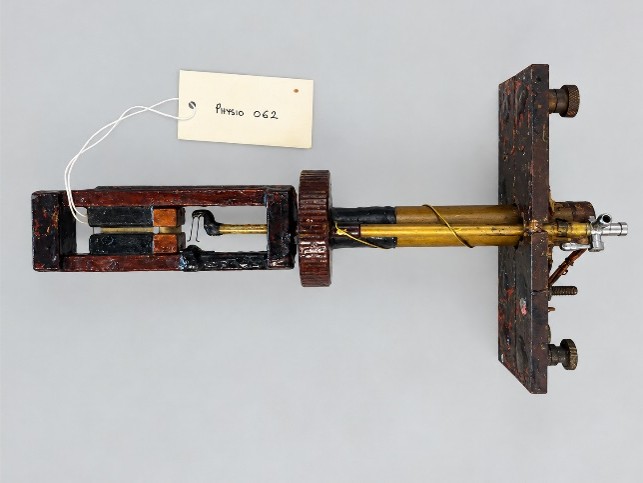
Figure 1: The thermopile made by A.V. Hill and Te-Pei Feng in 1933 and used to study thermodynamics of excitable tissues (Object LDUSC-PHYSIO-62 in UCL Science Collections).
Accurate measurement of temperature
Before Hill’s contribution, the main method of measuring muscle heat production was through thermocouples, first used by Hermann von Helmholtz (1821–1894) in 1848 to record heat released by the skeletal muscle of a frog [3]. In 1902, Swedish physiologist Magnus Blix (1849 – 1904) improved muscle thermopiles using copper-constantan thermocouples to study heat production during contraction [4]. At Cambridge, John N Langley (1852 – 1925) introduced Hill to a Blix thermopile and encouraged his mentee to investigate muscle as a thermodynamic machine [5].
Blix’s apparatus was sensitive, but it responded too slowly to determine precisely when heat was released during a rapid muscle twitch. This led Hill to develop increasingly sensitive thermopiles capable of detecting minute (~0.003°C) and rapid temperature changes produced by a single muscle twitch [6,7]. This was achieved through two main components: the thermocouples, which detected temperature changes in living muscle, and a highly sensitive galvanometer, which measured the resulting electrical signal. In later versions of the thermopile, the electrical signal was amplified using photoelectric amplification systems [8]. The thermopile was further refined by incorporating ‘dummy’ thermocouples beyond the active measuring region. These provided a protective region that reduced measurement artefacts caused by the movement and shortening of the muscle across the thermopile [9].
Heat production, muscle contraction and recovery
Hill’s thermopile allowed him to follow the very small temperature changes produced by isolated frog muscle. An unexpected observation was that the galvanometer did not return quickly to baseline after contraction. Instead, heat continued to be produced for several minutes after the mechanical contraction had finished [7]. Hill called this “recovery heat”. Crucially, he found that this delayed heat was substantial when oxygen was available but largely disappeared when the muscle was kept in nitrogen (Figure 2). In contrast, the initial heat associated with contraction could still occur without oxygen. This led to a major conceptual change: oxygen was not required directly for the muscle to contract; it was principally required afterwards, during recovery [10] (Figure 2).
Combined with Fletcher and Hopkins’ discovery of lactate accumulation in muscle, and Otto Meyerhof’s (1884 – 1951) discovery of the constant relation between oxygen consumption and lactate turnover in the muscle, these observations led to a new understanding of muscle. That it was a chemical machine that could release stored energy without oxygen and use oxygen during recovery to restore its energy reserves. Although the biochemical explanation was later revised following the discovery of ATP and phosphocreatine [2]. Hill’s thermopile experiments established the fundamental distinction between energy release during muscle contraction and subsequent metabolic recovery. This work helped shape our current understanding of oxidative metabolism. Hill’s studies of the thermodynamics of isolated muscle also led him to investigate the limits of whole-body exercise in humans. Together with Hartley Lupton (1892 – 1924), he established the concept of maximal oxygen uptake (VO2 max), describing an upper limit to oxygen consumption during intense exercise [11].
Hill shared the 1922 Nobel Prize in Physiology or Medicine with Meyerhof. The prize was announced one year later, in 1923, by which time Hill had succeeded Ernest Starling as Jodrell Professor of Physiology at UCL. Other Nobel laureates of 1922 included Niels Bohr (1885 – 1962), recognised for his work on atomic structure, and Francis Aston (1877-1945), for his discovery of isotopes using the mass spectrograph, milestone discoveries that transformed modern science.
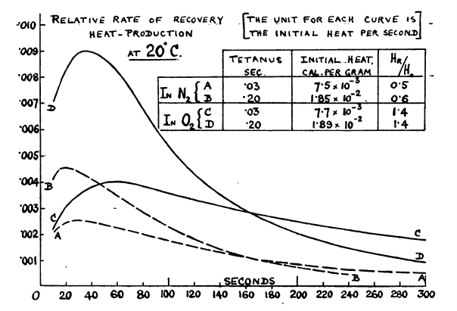
Figure 2: Delayed heat production in the presence and absence of oxygen after medium and short tetanic contractions. The figure is reproduced from Hartree and Hill’s 1922 report in The Journal of Physiology [10]. A and B show heat production in the absence of oxygen, while C and D show heat production in the presence of oxygen (horizontal axis: time in seconds, horizontal axis: changes in temperature in oC).
Refining the Thermopile
Many versions of the thermopile were developed by Hill and his collaborators. They used different combinations of metals to improve the response rate, as well as better insulation and shielding to minimise heat leakage from the stimulating electrodes [12,13]. Hill’s students helped to further refine the instrument, notably Te-Pei Feng, who worked with Hill to measure electrical gradients and heat production in muscle and nerves [14,15]. Te-Pei Feng (1907-1995) was a Chinese physiologist who became one of the founders of modern physiology and neuroscience in China. He had a particularly close scientific relationship with AV Hill while studying at UCL. The thermopile shown in Figures 1 and 3 is based on a version developed by Feng and Hill in 1933.
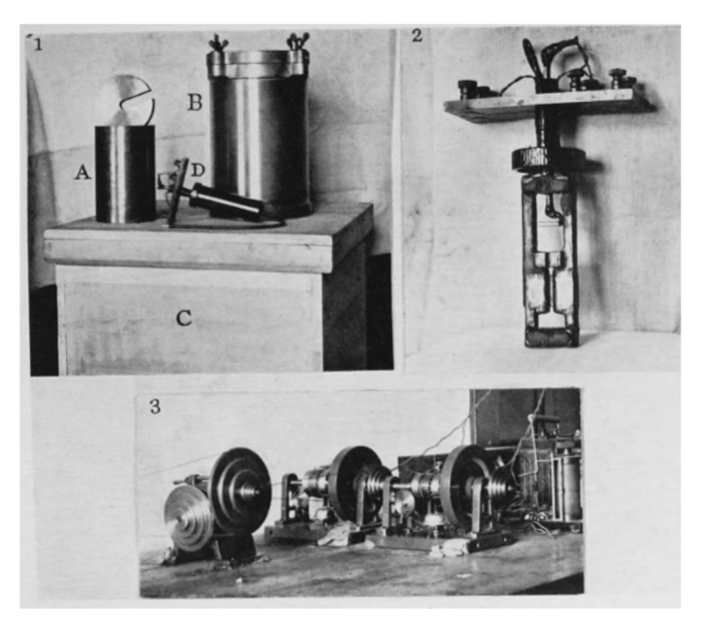
Figure 3: Hill and Feng’s thermopile, reproduced from their published paper [15]. The complete apparatus used alongside the thermopile is shown, including insulating materials (1), the thermopile itself (2), and commutators used to control tissue stimulation and quantitatively measure heat production (3).
Hill’s legacy
Hill’s legacy continues not only through his outstanding scientific work, combining mathematics and experimental physiology to address fundamental questions, but also through the leadership and science policy roles he undertook. He supported refugee scientists, promoted scientific collaboration during World War II, and helped shape science policy in the post-war period. He was one of the pioneers of exercise physiology and biophysics, providing an excellent example of how bringing expertise from another field can advance physiology.
In 1922, Ernest Starling wrote to his own daughter about Hill’s appointment at UCL:
‘‘I think I shall get A.V. Hill to succeed me … Foster (Sir Gregory Foster, Provost of UCL) had heard about him – & asked me. I said ‘‘Yes, I think he is the right man. But of course he is not a medical man, he is not even a physiologist. He is a physicist and a mathematician’’. Poor old Foster, it was as if the bottom had dropped out of his Universe. He gasped ‘‘But he is a professor of physiology’’. I said ‘‘Oh yes – he will do very well as head of this Institute’’ [16].
Acknowledgment: The authors are grateful to Alanna Orpen (The Physiological Society), Ignacio Echeverria Faccin, Graham Isted and Liz Blanks (UCL Museums & Cultural Collections) for their collaboration and expert advice.
Discover more about the history of physiology. If you’ve missed the previous blogs by the UCL Historic Objects and Collections team, you can read through the series from Bárány’s Box to the Kymograph to the Haldane apparatus. Enjoy more showcases of physiologists and artefacts with From Wills’ factor to folic acid; From squid giant axons to recording action potentials inside a nerve fibre; Measuring the invisible: The Hartridge Reversion Spectroscope; Winifred Cullis: Bringing human physiology to the public and From mentor to pupil: Starling, Verney, and the evolution of the heart-lung-kidney preparation.
References
- Fletcher WM, Hopkins FG. Lactic acid in amphibian muscle. Journal of Physiology. 1907;35(4):247–309.
- Bassett DR. Scientific contributions of A. V. Hill: exercise physiology pioneer. Journal of Applied Physiology. 2002; 93(5):1567–82.
- Loiselle DS, Johnston CM, Han J-C, Nielsen PMF, Taberner AJ. Muscle heat: a window into the thermodynamics of a molecular machine. American Journal of Physiology-Heart and Circulatory Physiology. 2016; 310(3):H311–25.
- Blix M. Studien über Muskelwärme. Skandinavisches Archiv für Physiologie. 1902;12:52–128.
- Hill AV. Heat Production of Muscle and Nerve. Nature. 1935;135:669–672.
- Hill AV. The heat produced in contracture and muscular tone. Journal of Physiology. 1910;40(5):389–403.
- Hill AV. The Mechanism of Muscular Contraction. Nobel Lecture, December 12, 1923. Nobel Prize in Physiology or Medicine 1922: https://www.nobelprize.org/prizes/medicine/1922/hill/lecture/
- Hill AV. A photoelectric relay for galvanometer measurements. Journal of Scientific Instruments. 1931 Aug;8(8):262-5.
- Hill AV. The heat of shortening and the dynamic constants of muscle. Proceedings of the Royal Society of London. Series B. 1938; 126(843):136–95.
- Hartree W, Hill AV. The recovery heat-production in muscle. Journal of Physiology. 1922;56:367–381.
- Hill AV, Lupton H. Muscular exercise, lactic acid, and the supply and utilization of oxygen. Quarterly Journal of Medicine. 1923;16(62):135–171.
- Science Museum Group Collection: Archibald V Hill’s thermopile used to measure heat production, England, 1950-1960. https://collection.sciencemuseumgroup.org.uk/objects/co116123/archibald-v-hills-thermopile-used-to-measure-heat-production-england-1950-1960.
- Hill AV. The three phases of nerve heat production. Proceedings of the Royal Society of London. Series B, 1933;113:345–356.
- Feng TP. The thermo-elastic properties of muscle. Journal of Physiol. 1932 Apr 26;74(4):455-70.
- Feng TP, Hill AV. The steady state of heat production of nerve. Proceedings of the Royal Society of London. Series B. 1933; 113(784):356-65.
- Henriksen JH. Starling, his contemporaries and the Nobel Prize. One hundred years with hormones. Scandinavian Journal of Clinical and Laboratory Investigation Supplement. 2003;238:1-59.